## Summary of the Pull Request
Adds logic such that local snippets from .wt.json files are imported not
only at the current directory, but also in the parent directories.
## References and Relevant Issues
Spec:
https://github.com/microsoft/terminal/blob/main/doc/specs/%231595%20-%20Suggestions%20UI/Snippets.md
## Validation Steps Performed
`D:\test\.wt.json`: contains `Hello --> hello (parent)`
`D:\test\inner_dir\.wt.json`: contains `Hello --> hello`
- In `D:\test\`...
- ✅ `Hello` command outputs `hello (parent)`
- ✅ commands from `inner_dir` not shown
- In `D:\test\inner_dir\`...
- ✅ `Hello` command outputs `hello`
- ✅ commands from `D:\test` are shown
## PR Checklist
Closes#17805
Adds functionality throughout the settings model to keep track of which
settings have been set.

There are two entry points:
- AppLogic.cpp: this is where we perform a settings reload by loading
the JSON
- MainPage.cpp: this is where the Save button is clicked in the settings
UI

Both of these entry points call into
`CascadiaSettings::LogSettingChanges()` where we aggregate the list of
changes (specifically, _which_ settings changed, not _what_ their value
is).

Just about all of the settings model objects now have a
`LogSettingChanges(std::set& changes, std::string_view context)` on
them.
- `changes` is where we aggregate all of the changes to. In it being a
set, we don't need to worry about duplicates and can do things like
iterate across all of the profiles.
- `context` prepends a string to the setting. This'll allow us to better
identify where a setting was changes (i.e. "global.X" are global
settings). We also use this to distinguish between settings set in the
~base layer~ profile defaults vs individual profiles.

The change log in each object is modified via two ways:
- `LayerJson()` changes: this is useful for detecting JSON changes! All
we're doing is checking if the setting has a value (due to inheritance,
just about everything is an optional here!). If the value is set, we add
the json key to the change log
- `INHERITABLE_SETTING_WITH_LOGGING` in IInheritable.h: we already use
this macro to define getters and setters. This new macro updates the
setter to check if the value was set to something different. If so, log
it!

 Other notes:
- We're not distinguishing between `defaultAppearance` and
`unfocusedAppearance`
- We are distinguishing between `profileDefaults` and `profile` (any
other profile)
- New Tab Menu Customization:
- we really just care about the entry types. Handled in
`GlobalAppSettings`
- Font:
- We still have support for legacy values here. We still want to track
them, but just use the modern keys.
- `Theme`:
- We don't do inheritance here, so we have to approach it differently.
During the JSON load, we log each setting. However, we don't have
`LayerJson`! So instead, do the work in `CascadiaSettings` and store the
changes there. Note that we don't track any changes made via setters.
This is fine for now since themes aren't even in the settings UI, so we
wouldn't get much use out of it anyways.
- Actions:
- Actions are weird because we can have nested and iterable actions too,
but `ActionsAndArgs` as a whole add a ton of functionality. I handled it
over in `Command::LogSettingChanges` and we generally just serialize it
to JSON to get the keys. It's a lot easier than dealing with the object
model.

Epic: #10000
Auto-Save (ish): #12424
Between fmt 7.1.3 and 11.0.2 a lot has happened. `wchar_t` support is
now more limited and implicit conversions don't work anymore.
Furthermore, even the non-`FMT_COMPILE` API is now compile-time checked
and so it fails to work in our UI code which passes `hstring` format
strings which aren't implicitly convertible to the expected type.
`fmt::runtime` was introduced for this but it also fails to work for
`hstring` parameters. To solve this, a new `RS_fmt` macro was added
to abstract the added `std::wstring_view` casting away.
Finally, some additional changes to reduce `stringstream` usage
have been made, whenever `format_to`, etc., is available.
This mostly affects `ActionArgs.cpp`.
Closes#16000
## Validation Steps Performed
* Compiles ✅
* Settings page opens ✅
* Every single place that called `read_file_as_utf8_string_if_exists`
  would immediately do a `.value_or(std::string{})`.
  As such, the function now returns a string directly.
* There was just one caller to `read_file_as_utf8_string`
  and it only cared about files that are non-empty.
  As such, the specialization got removed.

Both of these make sense to me, as in practice there's seldom
a difference between an empty file and a non-existent one.

## Validation Steps Performed
* Compiles ✅
* Starts ✅
* Deleting the `settings.json` contents triggers a reload ✅
This PR adds the ability to load snippets from the CWD into the
suggestions UI.

If shell integration is disabled, then we only ever think the CWD for a
pane is it's `startingDirectory`. So, in the default case, users can
still stick snippets into the root of their git repos, and have the
Terminal load them automatically (for profiles starting in the root of
their repo).
If it's enabled though, we'll always try to load snippets from the CWD
of the shell.

* We cache the actions into a separate map of CWD -> actions. This lets
us read the file only the first time we see a dir.
* We clear that cache on settings reload
* We only load `sendInput` actions from the `.wt.json`

As spec'd in #17329
In the spec review, we agreed these didn't really need to be saved to
the user's own settings file. This removes parsing and saving for the
`experimental.saveSnippet` action, but we still have the action
_internally_. This is powered by a new x-macro for "INTERNAL_" actions.

Follow-up from #16513.
Hi wanted to make an attempt at
[12857](https://github.com/microsoft/terminal/issues/12857). This still
needs work but I think the initial version is ready to be reviewed.
## Summary of the Pull Request
Mostly copied from:
6f5b9fb...1cde67ac46
- Save to disk
- If command line is empty use selection
- Show toast
- No UI. Trying out the different options now.
## PR Checklist
- [ ] Closes#12857
- [ ] Tests added/passed
- [ ] Documentation updated
- If checked, please file a pull request on [our docs
repo](https://github.com/MicrosoftDocs/terminal) and link it here: #xxx
- [ ] Schema updated (if necessary)
---------
Co-authored-by: Mike Griese <migrie@microsoft.com>
With the move to Action IDs, it doesn't quite make sense anymore for a
`Command` to know which keys map to it. This PR removes all `Keys` from
`Command`, and any callers to that now instead query the `ActionMap` for
that Command's keys.
Closes#17160Closes#13943
As outlined in #16816, refactor `ActionMap` to use the new action IDs
added in #16904
## Validation steps performed
- [x] Legacy style commands are parsed correctly (and rewritten to the
new format)
- [x] Actions are still layered correctly and their IDs can be used to
'overwrite' actions in earlier layers
- [x] Keybindings that refer to an ID defined in another layer work
correctly
- [x] User-defined actions without an ID have one generated for them
(and their settings file is edited with it)
- [x] Schema updated
Refs #16816Closes#17133
As laid out in #16816, adds an `ID` field to `Command`.

**This first PR only adds IDs for built-in commands in defaults, and
generates IDs for user-created commands that don't define an ID.** Also
note that for now we **will not** be allowing IDs for iterable/nested
commands.

The follow-up PR is where we will actually use the IDs by referring to
commands with them.

Refs #16816

## Validation Steps Performed
User-created commands in the settings file get rewritten with generated
IDs
_targets #15027_
Adds a new suggestion source, `tasks`, that allows a user to open the
Suggestions UI with `sendInput` commands saved in their settings.
`source` becomes a flag setting, so it can be combined like so:
```json
{
"keys": "ctrl+shift+h", "command": { "action": "suggestions", "source": "commandHistory", "useCommandline":true },
},
{
"keys": "ctrl+shift+y", "command": { "action": "suggestions", "source": "tasks", "useCommandline":false },
},
{
"keys": "ctrl+shift+b", "command": { "action": "suggestions", "source": ["all"], "useCommandline":true },
},
```
If a nested command has `sendInput` commands underneath it, this will
build a tree of commands that only include `sendInput`s as leaves (but
leave the rest of the nesting structure intact).
## References and Relevant Issues
Closes#1595
See also #13445
As spec'd in #14864
## Validation Steps Performed
Tested manually
## Summary

_In the days of old, the windows were sundered, each with its own
process, like the scattered stars in the sky. But a new age hath dawned,
for all windows now reside within a single process, like the bright gems
of a single crown._
_And lo, there came the `WindowEmperor`, a new lord to rule over the
global state, wielding the power of hotkeys and the beacon of the
notification icon. The `WindowManager` was cast aside, no longer needed
to seek out other processes or determine the `Monarch`._
_Should the `WindowEmperor` determine that a new window shall be raised,
it shall set forth a new thread, born from the ether, to govern this new
realm. On the main thread shall reside a message loop, charged with the
weighty task of preserving the global state, guarded by hotkeys and the
beacon of the notification icon._
_Each window doth live on its own thread, each guarded by the new
`WindowThread`, a knightly champion to hold the `TerminalWindow`,
`AppHost`, and `IslandWindow` in its grasp. And so the windows shall run
free, no longer burdened by their former ways._


All windows are now in a single process, rather than in one process per
window. We'll add a new `WindowEmperor` class to manage global state
such as hotkeys and the notification icon. The `WindowManager` has been
streamlined and no longer needs to connect to other processes or
determine a new `Monarch`. Each window will run on its own thread, using
the new `WindowThread` class to encapsulate the thread and manage the
`TerminalWindow`, `AppHost`, and `IslandWindow`.


* Related to #5000
* Related to #1256

## Windows Terminal Process Model 3.0

Everything is now one process. All the windows for a single Terminal
instance live in a singular Terminal process. When a new terminal
process launches, it will still attempt to communicate with an existing
one. If it finds one, it'll pass the commandline to that process and
exit. Otherwise, it'll become the "monarch" and create a new window.

We'll introduce a new abstraction here, called the `WindowEmperor`.
`Monarch` & `Peasant` will still remain, for facilitating cross-window
communication. The Emperor will allow us to have a single dedicated
class for all global state, and will now always represent the "monarch"
(rather than our previously established non-deterministic monarchy to
elevate a random peasant to the role of monarch). We still need to do a
very minimal amount of x-proc calls. Namely, one right on startup, to
see if another `Terminal.exe` was already running. If we find one, then
we toss our commandline at it and bail. If we don't, then we need to
`CoRegister` the Monarch still, to prepare for subsequent launches to
send commands to us.

`WindowManager` takes the most changes here. It had a ton of logic to
redundantly attempt to connect to other monarchs of other processes, or
elect a new one. It doesn't need to do any of that anymore, which is a
pretty dramatic change to that class.

This creates the opportunity to move some lifetime management around.
We've played silly games in the past trying to have individual windows
determine if they're the singular monarch for global state.
`IslandWindow`s no longer need to track things like global hotkeys or
the notification icon. The emperor can do that - there's only ever one
emperor. It can also own a singular copy of the settings model, and hand
out references to each other thread.

Each window lives on separate threads. We'll need to separately
initialize XAML islands for each thread. This is totally fine, and
actually supported these days. We'll use a new class called
`WindowThread` to encapsulate one of these threads. It'll be responsible
for owning the `TerminalWindow`, `AppHost` and `IslandWindow` for a
single thread.

This introduces new classes of bugs we'll need to worry about. It's now
easier than ever to have "wrong thread" bugs when interacting with any
XAML object from another thread. A good case in point - we used to stash
a `static` `Brush` in `Pane`, for the color of the borders. We can't do
that anymore! The first window will end up stashing a brush from its
thread. So now when a second window starts, the app explodes, because
the panes of that window try to draw their borders using a brush from
the wrong thread.

_Another fun change_: The keybinding labels of the command palette.
`TerminalPage` is the thing that ends up expanding iterable `Command`s.
It does this largely with copies - it makes a new `map`, a new `vector`,
copies the `Command`s over, and does the work there before setting up
the cmdpal.
Except, it's not making a copy of the `Command`s, it's making a copy of
the `vector`, with winrt objects all pointing at the `Command` objects
that are ultimately owned by `CascadiaSettings`.
This doesn't matter if there's only one `TerminalPage` - we'll only ever
do that once. However, now there are many Pages, on different threads.
That causes one `TerminalPage` to end up expanding the subcommands of a
`Command` while another `TerminalPage` is ALSO iterating on those
subcommands.

_Emperor message window_: The Emperor will have its own HWND, that's
entirely unrelated to any terminal window. This window is a
`HWND_MESSAGE` window, which specifically cannot be visible, but is
useful for getting messages. We'll use that to handle the notification
icon and global hotkeys. This alleviates the need for the IslandWindow
to raise events for the tray icon up to the AppHost to handle them. Less
plumbing=more good.

### Class ownership diagram

_pretend that I know UML for a second_:

```mermaid
classDiagram
    direction LR
    class Monarch
    class Peasant
    class Emperor
    class WindowThread
    class AppHost

    Monarch "1" --o "*" Peasant: Tracks
    Emperor --* "1" AppLogic:
    Monarch <..> "1" Emperor
    Peasant "1" .. "1" WindowThread
    Emperor "1" --o "*" WindowThread: Tracks
    WindowThread --* AppHost
    AppHost --* IslandWindow
    AppHost --* TerminalWindow
    TerminalWindow --* TerminalPage
```

* There's still only one `Monarch`. One for the Terminal process.
* There's still many `Peasant`s, one per window.
* The `Monarch` is no longer associated with a window. It's associated
with the `Emperor`, who maintains _all_ the Terminal windows (but is not
associated with any particular window)
* It may be relevant to note: As far as the `Remoting` dll is concerned,
it doesn't care if monarchs and peasants are associated with windows or
not. Prior to this PR, _yes_, the Monarch was in fact associated with a
specific window (which was also associated with a window). Now, the
monarch is associated with the Emperor, who isn't technically any of the
windows.
* The `Emperor` owns the `App` (and by extension, the single `AppLogic`
instance).
* Each Terminal window lives on its own thread, owed by a `WindowThread`
object.
* There's still one `AppHost`, one `IslandWindow`, one `TerminalWindow`
& `TerminalPage` per window.
* `AppLogic` hands out references to its settings to each
`TerminalWindow` as they're created.

### Isolated Mode

This was a bit of a tiny brainstorm Dustin and I discussed. This is a
new setting introduced as an escape watch from the "one process to rule
them all" model. Technically, the Terminal already did something like
this if it couldn't find a `Monarch`, though, we were never really sure
if that hit. This just adds a setting to manually enable this mode.

In isolated mode, we always instantiate a Monarch instance locally,
without attempting to use the `CoRegister`-ed one, and we _never_
register one. This prevents the Terminal from talking with other
windows.
* Global hotkeys won't work right
* Trying to run commandlines in other windows (`wt -w foo`) won't work
* Every window will be its own process again
* Tray icon behavior is left undefined for now.
* Tab tearout straight-up won't work.

### A diagram about settings

This helps explain how settings changes get propagated

```mermaid
sequenceDiagram
    participant Emperor
    participant AppLogic

    participant AppHost
    participant TerminalWindow
    participant TerminalPage

    Note Right of AppLogic: AL::ReloadSettings
    AppLogic ->> Emperor: raise SettingsChanged
    Note left of Emperor: E::...GlobalHotkeys
    Note left of Emperor: E::...NotificationIcon
    AppLogic ->> TerminalWindow: raise SettingsChanged<br>(to each window)
    AppLogic ->> TerminalWindow:
    AppLogic ->> TerminalWindow:
    Note right of TerminalWindow: TW::UpdateSettingsHandler
    Note right of TerminalWindow: TW::UpdateSettings
    TerminalWindow ->> TerminalPage: SetSettings
    TerminalWindow ->> AppHost: raise SettingsChanged
    Note right of AppHost: AH::_HandleSettingsChanged
```
## Summary of the Pull Request
As described in #9583, this change implements the legacy conhost "EnableColorSelection" feature.
## Detailed Description of the Pull Request / Additional comments
@zadjii-msft was super nice and provided the outline/plumbing (WinRT classes and such) as a hackathon-type project (thank you!)--a "SelectionColor" runtimeclass, a ColorSelection method on the ControlCore runtimeclass, associated plumbing through the layers; plus the action-and-args plumbing to allow hooking up a basic "ColorSelection" action, which allows you to put actions in your settings JSON like so:
```json
{
"command":
{
"action": "experimental.colorSelection",
"foreground": "#0f3"
},
"keys": "alt+4"
},
```
On top of that foundation, I added a couple of things:
* The ability to specify indexes for colors, in addition to RGB and RRGGBB colors.
- It's a bit hacky, because there are some conversions that fight against sneaking an "I'm an index" flag in the alpha channel.
* A new "matchMode" parameter on the action, allowing you to say if you want to only color the current selection ("0") or all matches ("1").
- I made it an int, because I'd like to enable at least one other "match mode" later, but it requires me/someone to fix up search.cpp to handle regex first.
- Search used an old UIA "ColorSelection" method which was previously `E_NOTIMPL`, but is now wired up. Don't know what/if anything else uses this.
* An uber-toggle setting, "EnableColorSelection", which allows you to set a single `bool` in your settings JSON, to light up all the keybindings you would expect from the legacy "EnableColorSelection" feature:
- alt+[0..9]: color foreground
- alt+shift+[0..9]: color foreground, all matches
- ctrl+[0..9]: color background
- ctrl+shift+[0..9]: color background, all matches
* A few of the actions cannot be properly invoked via their keybindings, due to #13124. `*!*` But they work if you do them from the command palette.
* If you have "`EnableColorSelection : true`" in your settings JSON, but then specify a different action in your JSON that uses the same key binding as a color selection keybinding, your custom one wins, which I think is the right thing.
* I fixed what I think was a bug in search.cpp, which also affected the legacy EnableColorSelection feature: due to a non-inclusive coordinate comparison, you were not allowed to color a single character; but I see no reason why that should be disallowed. Now you can make all your `X`s red if you like.
"Soft" spots:
* I was a bit surprised at some of the helpers I had to provide in textBuffer.cpp. Perhaps there are existing methods that I didn't find?
* Localization? Because there are so many (40!) actions, I went to some trouble to try to provide nice command/arg descriptions. But I don't know how localization works…
<!-- Please review the items on the PR checklist before submitting-->
## PR Checklist
* [x] Closes#9583
* [x] CLA signed. If not, go over [here](https://cla.opensource.microsoft.com/microsoft/Terminal) and sign the CLA
* [ ] Tests added/passed *(what would be the right place to add tests for this?)*
* [ ] Documentation updated. If checked, please file a pull request on [our docs repo](https://github.com/MicrosoftDocs/terminal) and link it here: #xxx
* [ ] Schema updated. *(is this needed?)*
* [x] I've discussed this with core contributors already. If not checked, I'm ready to accept this work might be rejected in favor of a different grand plan. Issue number where discussion took place: #xxx
## Validation Steps Performed
Just manual testing.
#4015 requires sweeping changes in order to allow a migration of our buffer
coordinates from `int16_t` to `int32_t`. This commit reduces the size of
future commits by using type inference wherever possible, dropping the
need to manually adjust types throughout the project later.

As an added bonus this commit standardizes the alignment of cv qualifiers
to be always left of the type (e.g. `const T&` instead of `T const&`).

The migration to type inference with `auto` was mostly done
using JetBrains Resharper with some manual intervention and the
standardization of cv qualifier alignment using clang-format 14.

## References

This is preparation work for #4015.

## Validation Steps Performed
* Tests pass ✅
00fe2b0 made the mistake of hashing the pointer of `NewTerminalArgs` instances
instead of their content. This commit calls `NewTerminalArgs::Hash` instead.

## PR Checklist
* [x] I work here
* [x] Tests added/passed

## Validation Steps Performed
* New test passes ✅
This commit serves two purposes:
* Simplify construction of hashes for non-trivial structs
  This is especially helpful for ActionArgs
* Improve hash quality by not needlessly throwing away entropy

`til::hasher` is modeled after Rust's `std:#️⃣:Hasher` and works similar.
The idea is simple: A stateful hash function can hash multiple unrelated fields,
without loosing entropy by running a finalizer after hashing each interim field.
This is especially useful for modern hash functions, which often have a wider
internal state than the output width. Additionally this improves performance
for hash functions with complex finalizers.

Most of this is of course a bit moot right now, considering that `til::hasher`
is still based on STL's FNV1a algorithm, which offers a very poor hash quality.
But counterintuitively, FNV1a actually benefits most from this PR: Since it
lacks a finalizer entirely, this commit greatly improves hash quality as
it encodes more data into FNV's state and thus improves randomness.

## PR Checklist
* [x] I work here
* [x] Tests added/passed

## Validation Steps Performed
* No unusual behavior ✅
## Summary of the Pull Request
Fixes two issues related to SUI's Actions page:
1. Crash when adding an action and setting key chord to one that is already taken
- **Cause**: the new key binding that was introduced with the "Add new" button appears in `_KeyBindingList` that we're iterating over. This has no `CurrentKeys()`, resulting in a null pointer exception.
- **Fix**: null-check it
2. There's an action that appears as being nameless in the dropdown
- **Cause**: The culprit seems to be `MultipleActions`. We would register it, but it wouldn't have a name, so it would appear as a nameless option.
- **Fix**: if it has no name, don't register it. This is also future-proof in that any new nameless actions won't be automatically added.
Closes#10981
Part of #11353
This commit partially reverts d465a47 and introduces an alternative approach by adding Hash and Equals methods to the KeyChords class. Those methods will now favor any existing Vkeys over ScanCodes.
## PR Checklist
* [x] Closes#10933
* [x] I work here
* [x] Tests added/passed
## Validation Steps Performed
* Added a new test, which is ✔️
* Various standard commands still work ✔️
* Hash() returns the same value for all KeyChords that are Equals() ✔️
The quake mode keybinding is bound to a scancode. This made it
impossible to override it with a vkey-based one like "win+\`".
This commit fixes the issue by making sure that a `KeyChord` always has a vkey,
and leveraging this fact inside ActionMap, which now ignores the scan-code.
## PR Checklist
* [x] Closes#10875
* [x] I work here
* [x] Tests added/passed
## Validation Steps Performed
* quake mode and other keybinding still work ✔️
* Repro settings from #10875 work correctly ✔️
My first approach to solve #10875 failed.
This PR contains the most useful change as a separate commit.

## PR Checklist
* [x] I work here
* [x] Tests added/passed

## Validation Steps Performed

* quake mode keybinding works ✔️
* command palette still works ✔️
<!-- Enter a brief description/summary of your PR here. What does it fix/what does it change/how was it tested (even manually, if necessary)? -->
## Summary of the Pull Request
This PR implements/solves #7125. Concretely: two requests regarding alt+space were posted there:
1. Disabling the alt+space menu when the keychord explicitly unbound - and forwarding the keystroke to the terminal
2. Disabling the alt+space menu when the keychord is bound to an action
<!-- Other than the issue solved, is this relevant to any other issues/existing PRs? -->
## References
Not that I know
<!-- Please review the items on the PR checklist before submitting-->
## PR Checklist
* [x] Closes#7125
* [x] CLA signed.
* [x] Tests added/passed
* [x] Documentation updated. N/A
* [x] Schema updated.
* [ ] I've discussed this with core contributors already. If not checked, I'm ready to accept this work might be rejected in favor of a different grand plan.
The issue was marked Help-Wanted. I am happy to change the implementation to better fit your (planned) architecture.
<!-- Provide a more detailed description of the PR, other things fixed or any additional comments/features here -->
## Detailed Description of the Pull Request / Additional comments
While researching the solution, I noticed that the XAML system was always opening the system menu after Alt+Space, even when explicitly setting the event to be handled according to the documentation. The only solution I could find was to hook into the "XAML bypass" already in place for F7 KeyDown, and Alt KeyUp keystrokes. This bypass sends the keystroke to the AppHost immediately. This bypass method will "fall back" to the normal XAML routing when the keystroke is not handled.
The implemented behaviour is as follows:
- Default: same as normal; system menu is working since the bypass does not handle the keystroke
- Alt+Space explicitly unbound: bypass passes the keystroke to the terminal and marks it as handled
- Alt+Space bound to command: bypass invokes the command and marks it as handled
Concretely, added a method to the KeyBindings and ActionMap interfaces to check whether a keychord is explicitly unbound. The implementation for `_GetActionByKeyChordInternal` already distinguishes between explicitly unbound and lack of binding, however this distinction is not carried over to the public methods. I decided not to change this existing method, to avoid breaking other stuff and to make the API more explicit.
Furthermore, there were some checks against Alt+Space further down in the code, preventing this keystroke from being entered in the terminal. Since the check for this keystroke is now done at a "higher" level, I thought I could safely remove these checks as otherwise the keystroke could never be sent to the terminal itself. Please correct me if I'm wrong.
Note that when alt+space is bound to an action that opens the command pallette (such as tab search), then a second press of the key combination does still open the system menu. This is because at that point, the "bypass" is cancelled (called "not a good implementation" in #4031). I don't think this can easily be solved for now, but this is a very minor bug/inconvenience.
<!-- Describe how you validated the behavior. Add automated tests wherever possible, but list manual validation steps taken as well -->
## Validation Steps Performed
Added tests for the new method. Performed manual checking:
* [x] Default configuration still opens system menu like normal
* [x] Binding alt+space to an action performs the action and does not show the system menu
* [x] Explicitly unbinding alt+space no longer shows the system menu and sends the keystroke to the terminal. I was unable to run the debug tap (it crashed my instance - same thing happening on preview and release builds) to check for sure, but behaviour was identical to native linux terminals.
This commit introduces an alternative to specifying key bindings as a combination of key modifiers and a character. It allows you to specify an explicit virtual key as `vk(nnn)`.
Additionally this commit makes it possible to bind actions to scan codes. As scan code 41 appears to be the button below the Escape key on virtually all keyboards, we'll be able to bind the quake mode hotkey to `win+sc(41)` and have it work consistently across most if not all keyboard layouts.
## PR Checklist
* [x] Closes#7539, Closes#10203
* [x] I work here
* [x] Tests added/passed
## Validation Steps Performed
The following was tested both on US and DE keyboard layouts:
* Ctrl+, opens settings ✔️
* Win+` opens quake mode window ✔️
* Ctrl+plus/minus increase/decrease font size ✔️
This introduces the ability to set the action for a key binding. A combo box is used to let the user select a new action.

## References
#6900 - Actions page Epic
#9427 - Actions page design doc
#9949 - Actions page PR

## Detailed Description of the Pull Request / Additional comments
### Settings Model Changes
- `ActionAndArgs`
   - new ctor that just takes a `ShortcutAction`
- `ActionMap`
   - `AvailableActions` provides a map of all the "acceptable" actions to choose from. This is a merged list of (1) all `{ "command": X }` style actions and (2) any actions with args that are already defined in the ActionMap (or any parents).
   - `RegisterKeyBinding` introduces a new unnamed key binding to the action map.

### Editor Changes
- XAML
   - Pretty straightforward, when in edit mode, we replace the text block with a combo box. This combo box just presents the actions you can choose from.
- `RebindKeysEventArgs` --> `ModifyKeyBindingEventArgs`
- `AvailableActionAndArgs`
   - stores the list of actions to choose from in the combo box
   - _Unfortunately_, `KeyBindingViewModel` needs this so that we can populate the combo box
   - `Actions` stores and maintains this though. We populate this from the settings model on navigation.
- `ProposedAction` vs `CurrentAction`
   - similar to `ProposedKeys` and `Keys`, we need a way to distinguish the value from the settings model and the value of the control (i.e. combo box).
   - `CurrentAction` --> settings model
   - `ProposedAction` --> combo box selected item

## Validation Steps Performed
- Cancel:
   - ✔️ change action --> cancel button --> begin editing action again --> original action is selected
- Accept:
   - ✔️ don't change anything
   - ✔️ change action --> OK! --> Save!
      - NOTE: The original action is still left as a stub `{ "command": "closePane" }`. This is intentional because we want to prevent all modifications to the command palette.
   - ✔️ change action & change key chord --> OK! --> Save!
   - ✔️ change action & change key chord (conflicting key chord) --> OK! --> click ok on flyout --> Save!
      - NOTE: original action is left as a stub; original key chord explicitly unbound; new command/keys combo added.
## Summary of the Pull Request
#10297 found a bug in `ActionMap` where the `ToggleCommandPalette` key chord could not be found using `GetKeyBindingForAction`.

This was caused by the following:
- `AddAction`: when adding the action, the `ActionAndArgs` is basically added as `{ToggleCommandPalette, ToggleCommandLineArgs{}}` (Note the default ctor used for the action args)
- `GetKeyBindingForAction`: we're searching for an `ActionAndArgs` structured as `{ToggleCommandPalette, nullptr}`
- Since these are _technically_ two different actions, we are unable to find it.

This issue was fixed by making the `Hash(ActionAndArgs)` function smarter! If the `ActionAndArgs` has no args, but the `ShortcutAction` _supports_ args, generate the args using the default ctor.

By making `Hash()` smarter, everybody benefits from this logic! We can basically now enforce that `ActionAndArgs{ <X>, nullptr } == ActionAndArgs{ <X>, <default_ctor> }`.

## Validation Steps Performed
- Added a test.
- Tested this on #10297's branch and this does fix the bug
## Summary of the Pull Request
Fixes a bug where top-level iterable commands were not serialized.
## PR Checklist
* [X] Closes#10365
* [X] Tests added/passed
## Detailed Description of the Pull Request / Additional comments
- `Command::ToJson`:
- iterable commands deserve the same treatment as nested commands
- `ActionMap`:
- Similar to how we store nested commands, iterable commands need to be handled separately from standard commands. Then, when generating the name map, we make sure we export the iterable commands at the same time we export the nested commands.
Applies feedback from https://github.com/microsoft/terminal/pull/9949#pullrequestreview-662590658
Highlights include:
- bugfix: make all edit buttons stay visible if the user is using assistive technology
- rename a few functions and resources to match the correct naming scheme
- update the localized text for a conflicting key chord being assigned
- provide better comments throughout the actions page code
## References
#9949 - Original PR
Closes#10168
## Summary of the Pull Request
This PR lays the foundation for a new Actions page in the Settings UI as designed in #6900. The Actions page now leverages the `ActionMap` to display all of the key bindings and allow the user to modify the associated key chord or delete the key binding entirely.
## References
#9621 - ActionMap
#9926 - ActionMap serialization
#9428 - ActionMap Spec
#6900 - Actions page
#9427 - Actions page design doc
## Detailed Description of the Pull Request / Additional comments
### Settings Model Changes
- `Command::Copy()` now copies the `ActionAndArgs`
- `ActionMap::RebindKeys()` handles changing the key chord of a key binding. If a conflict occurs, the conflicting key chord is overwritten.
- `ActionMap::DeleteKeyBinding()` "deletes" a key binding by binding "unbound" to the given key chord.
- `ActionMap::KeyBindings()` presents another view (similar to `NameMap`) of the `ActionMap`. It specifically presents a map of key chords to commands. It is generated similar to how `NameMap` is generated.
### Editor Changes
- `Actions.xaml` is mainly split into two parts:
- `ListView` (as before) holds the list of key bindings. We _could_ explore the idea of an items repeater, but the `ListView` seems to provide some niceties with regards to navigating the list via the key board (though none are selectable).
- `DataTemplate` is used to represent each key binding inside the `ListView`. This is tricky because it is bound to a `KeyBindingViewModel` which must provide _all_ context necessary to modify the UI and the settings model. We cannot use names to target UI elements inside this template, so we must make the view model smart and force updates to the UI via changes in the view model.
- `KeyBindingViewModel` is a view model object that controls the UI and the settings model.
There are a number of TODOs in Actions.cpp will be long-term follow-ups and would be nice to have. This includes...
- a binary search by name on `Actions::KeyBindingList`
- presenting an error when the provided key chord is invalid.
## Demo
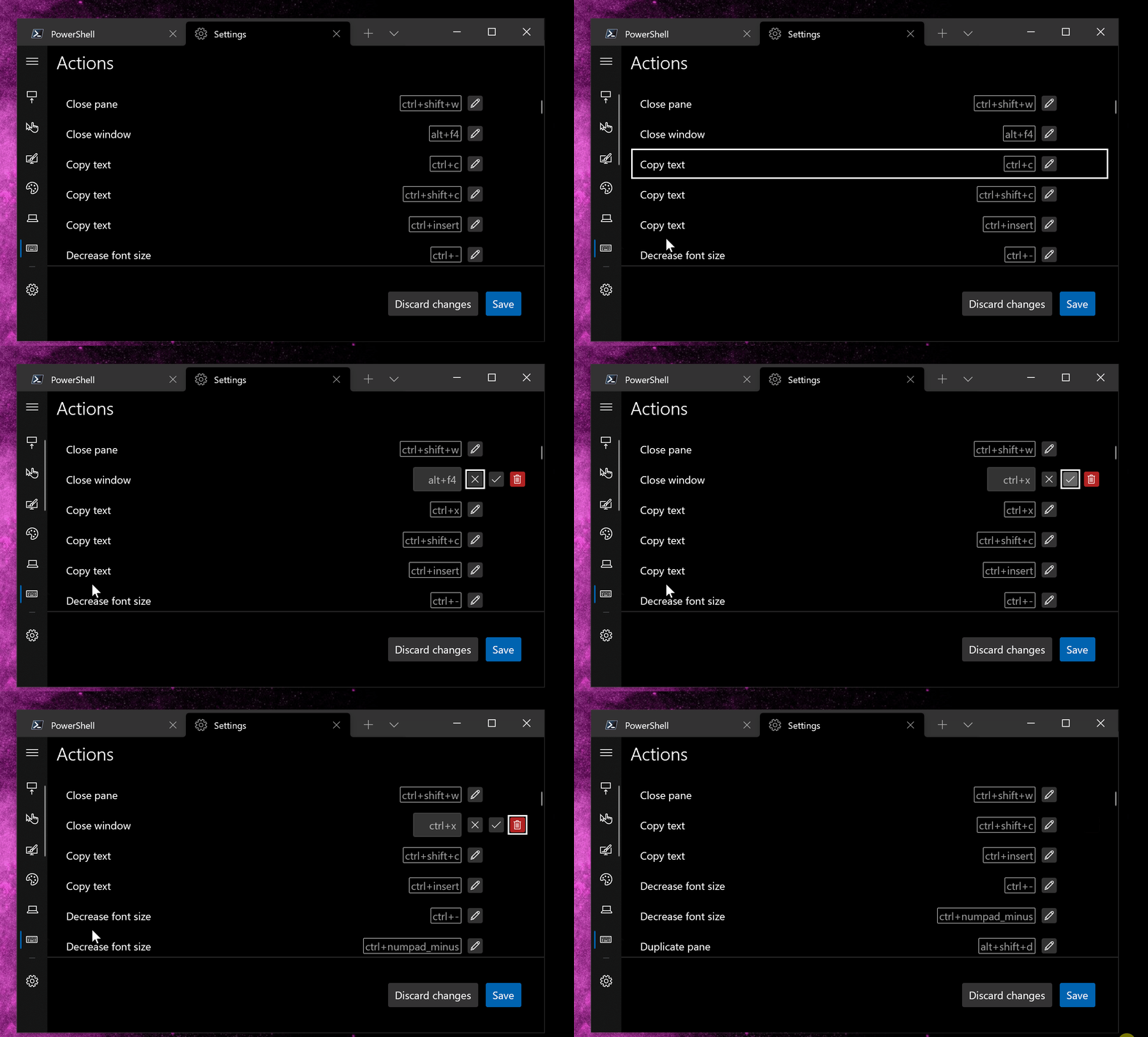
This entirely removes `KeyMapping` from the settings model, and builds on the work done in #9543 to consolidate all actions (key bindings and commands) into a unified data structure (`ActionMap`).
## References
#9428 - Spec
#6900 - Actions page
Closes#7441
## Detailed Description of the Pull Request / Additional comments
The important thing here is to remember that we're shifting our philosophy of how to interact/represent actions. Prior to this, the actions arrays in the JSON would be deserialized twice: once for key bindings, and again for commands. By thinking of every entry in the relevant JSON as a `Command`, we can remove a lot of the context switching between working with a key binding vs a command palette item.
#9543 allows us to make that shift. Given the work in that PR, we can now deserialize all of the relevant information from each JSON action item. This allows us to simplify `ActionMap::FromJson` to simply iterate over each JSON action item, deserialize it, and add it to our `ActionMap`.
Internally, our `ActionMap` operates as discussed in #9428 by maintaining a `_KeyMap` that points to an action ID, and using that action ID to retrieve the `Command` from the `_ActionMap`. Adding actions to the `ActionMap` automatically accounts for name/key-chord collisions. A `NameMap` can be constructed when requested; this is for the Command Palette.
Querying the `ActionMap` is fairly straightforward. Helper functions were needed to be able to distinguish an explicit unbinding vs the command not being found in the current layer. Internally, we store explicitly unbound names/key-chords as `ShortcutAction::Invalid` commands. However, we return `nullptr` when a query points to an unbound command. This is done to hide this complexity away from any caller.
The command palette still needs special handling for nested and iterable commands. Thankfully, the expansion of iterable commands is performed on an `IMapView`, so we can just expose `NameMap` as a consolidation of `ActionMap`'s `NameMap` with its parents. The same can be said for exposing key chords in nested commands.
## Validation Steps Performed
All local tests pass.

