This PR fixes issue #7130 where WT_SESSION and WT_PROFILE_ID environment
variables were being duplicated in the WSLENV environment variable when
multiple terminal sessions were created.
The previous implementation always appended WT_SESSION:WT_PROFILE_ID: to
WSLENV without checking if these variables already existed, causing
duplication.
Closes#7130
Co-authored-by: Leonard Hecker <lhecker@microsoft.com>
Introduces an ABI change to the ConptyClearPseudoConsole signal.
Otherwise, we have to make it so that the API call always retains
the row the cursor is on, but I feel like that makes it worse.
Closes#18732Closes#18878
## Validation Steps Performed
* Launch `ConsoleMonitor.exe`
* Create some text above & below the cursor in PowerShell
* Clear Buffer
* Buffer is cleared except for the cursor row ✅
* ...same in ConPTY ✅
Add additional information to 2 error scenarios when launching a
different profile in the `ConptyConnection.cpp` file.
- Requires Elevation
- File Not Found
Created a profile that required elevation and verified the error
message. Created profile that passed a made up command and verified the
error message.
Closes#7186
I've received a dump from an affected user, and it showed that the
layout event in TerminalPage was raised synchronously. This meant that
during page initialization, the handoff listener was started while still
being stuck inside the handoff listener. This resulted in a deadlock.
This PR fixes the issue by not holding the lock across handoff callback
calls.
Closes#18634
## Validation Steps Performed
* Can't repro ❌
`ResizeWindow` event in `TerminalApi` is handled and bubbled to
`TerminalApi->ControlCore->TermControl->TerminalPage->AppHost`. Resizing
is accepted only if the window is not in fullscreen or quake mode, and
has 1 tab and pane.

Relevant issues: #5094
This PR clones `winrt::fire_and_forget` and replaces the uncaught
exception handler with one that logs instead of terminating.
My hope is that this removes one source of random crashes.

## Validation Steps Performed
I added a `THROW_HR` to `TermControl::UpdateControlSettings`
before and after the suspension point and ensured the application
won't crash anymore.
`HSTRING` does not permit strings that aren't null-terminated.
As such we'll simply use a plain char array which compiles down to
a `UINT32` and `wchar_t*` pointer pair. Unfortunately, cppwinrt uses
`char16_t` in place of `wchar_t`, and also offers no trivial conversion
between `winrt::array_view` and `std::wstring_view` either.
As such, most of this PR is about explicit type casting.
Closes#17697
## Validation Steps Performed
* Patch the `DeviceAttributes` implementation in `adaptDispatch.cpp`
to respond like this:
```cpp
_api.ReturnResponse({L"ABCD", 3});
```
* Open a WSL shell and execute this:
```sh
printf "\e[c"; read
```
* Doesn't crash ✅
Between fmt 7.1.3 and 11.0.2 a lot has happened. `wchar_t` support is
now more limited and implicit conversions don't work anymore.
Furthermore, even the non-`FMT_COMPILE` API is now compile-time checked
and so it fails to work in our UI code which passes `hstring` format
strings which aren't implicitly convertible to the expected type.
`fmt::runtime` was introduced for this but it also fails to work for
`hstring` parameters. To solve this, a new `RS_fmt` macro was added
to abstract the added `std::wstring_view` casting away.
Finally, some additional changes to reduce `stringstream` usage
have been made, whenever `format_to`, etc., is available.
This mostly affects `ActionArgs.cpp`.
Closes#16000
## Validation Steps Performed
* Compiles ✅
* Settings page opens ✅
The idea is that we can translate Console API calls directly to VT at
least as well as the current VtEngine setup can. For instance, a call
to `SetConsoleCursorPosition` clearly translates directly to a `CUP`
escape sequence. Effectively, instead of translating output
asynchronously in the renderer thread, we'll do it synchronously
right during the Console API call.
Most importantly, the this means that any VT output that an
application generates will now be given to the terminal unmodified.
Aside from reducing our project's complexity quite a bit and opening
the path towards various interesting work like sixels, Device Control
Strings, buffer snapshotting, synchronized updates, and more, it also
improves performance for mixed text output like enwik8.txt in conhost
to 1.3-2x and in Windows Terminal via ConPTY to roughly 20x.
This adds support for overlapped IO, because now that output cannot
be "skipped" anymore (VtEngine worked like a renderer after all)
it's become crucial to block conhost as little as possible.
⚠️ Intentionally unresolved changes/quirks:
* To force a delayed EOL wrap to wrap, `WriteCharsLegacy` emits a
`\r\n` if necessary. This breaks text reflow on window resize.
We cannot emit ` \r` the way readline does it, because this would
overwrite the first column in the next row with a whitespace.
The alternative is to read back the affected cell from the buffer
and emit that character and its attributes followed by a `\r`.
I chose to not do that, because buffer read-back is lossy (= UCS2).
Unless the window is resized, the difference is unnoticeable
and historically, conhost had no support for buffer reflow anyway.
* If `ENABLE_VIRTUAL_TERMINAL_PROCESSING` is set while
`DISABLE_NEWLINE_AUTO_RETURN` is reset, we'll blindly replace all
LF with CRLF. This may hypothetically break DCS sequences, but it's
the only way to do this without parsing the given VT string and
thus the only way we can achieve passthrough mode in the future.
* `ENABLE_WRAP_AT_EOL_OUTPUT` is translated to `DECAWM`.
Between Windows XP and Windows 11 21H2, `ENABLE_WRAP_AT_EOL_OUTPUT`
being reset would cause the cursor position to reset to wherever
a write started, _if_ the write, including expanded control chars,
was less than 100 characters long. If it was longer than that,
the cursor position would end up in an effectively random position.
After lengthy research I believe that this is a bug introduced in
Windows XP and that the original intention was for this mode to be
equivalent to `DECAWM`. This is compounded by MSDN's description
(emphasis mine):
> If this mode is disabled, the **last character** in the row is
> overwritten with any subsequent characters.
⚠️ Unresolved issues/quirks:
* Focus/Unfocus events are injected into the output stream without
checking whether the VT output is currently in a ground state.
This may break whatever VT sequence is currently ongoing.
This is an existing issue.
* `VtIo::Writer::WriteInfos` should properly verify the width of
each individual character.
* Using `SetConsoleActiveScreenBuffer` destroys surrogate pairs
and extended (VT) attributes. It could be translated to VT pages
in the long term.
* Similarly, `ScrollConsoleScreenBuffer` results in the same and
could be translated to `DECCRA` and `DECFRA` in the near term.
This is important because otherwise `vim` output may loose
its extended attributes during scrolling.
* Reflowing a long line until it wraps results in the cooked read
prompt to be misaligned vertically.
* `SCREEN_INFORMATION::s_RemoveScreenBuffer` should trigger a
buffer switch similar to `SetConsoleActiveScreenBuffer`.
* Translation of `COMMON_LVB_GRID_HORIZONTAL` to `SGR 53` was dropped
and may be reintroduced alongside `UNDERSCORE` = `SGR 4`.
* Move the `OSC 0 ; P t BEL` sequence to `WriteWindowTitle`
and swap the `BEL` with the `ST` (`ESC \`).
* PowerShell on Windows 10 ships with PSReadLine 2.0.0-beta2
which emits SGR 37/40 instead of 39/49. This results in black
spaces when typing and there's no good way to fix that.
* A test is missing that ensures that `FillConsoleOutputCharacterW`
results in a `CSI n J` during the PowerShell shim.
* A test is missing that ensures that `PtySignal::ClearBuffer`
does not result in any VT being generated.
Closes#262Closes#1173Closes#3016Closes#4129Closes#5228Closes#8698Closes#12336Closes#15014Closes#15888Closes#16461Closes#16911Closes#17151Closes#17313
Without a renderer in #17510 we cannot skip "frames" anymore.
As such, using overlapped IO becomes crucial to avoid a regression
in performance. ITerminalHandoff3 fixes this by allowing the terminal
to pick the pipes it wants, which mirrors CreatePseudoConsole
where the caller can also pick its own pipes.

## Validation Steps Performed
* Do a handoff with the dev build
* Input/Output works ✅
First, this adds `GraphemeTableGen` which
* parses `ucd.nounihan.grouped.xml`
* computes the cluster break property for each codepoint
* computes the East Asian Width property for each codepoint
* compresses everything into a 4-stage trie
* computes a LUT of cluster break rules between 2 codepoints
* and serializes everything to C++ tables and helper functions

Next, this adds `GraphemeTestTableGen` which
* parses `GraphemeBreakTest.txt`
* splits each test into graphemes and break opportunities
* and serializes everything to a C++ table for use as unit tests

`CodepointWidthDetector.cpp` was rewritten from scratch to
* use an iterator struct (`GraphemeState`) to maintain state
* accumulate codepoints until a break opportunity arises
* accumulate the total width of a grapheme
* support 3 different measurement modes: Grapheme clusters,
  `wcswidth`-style, and a mode identical to the old conhost

With this in place the following changes were made:
* `ROW::WriteHelper::_replaceTextUnicode` now uses the new
  grapheme cluster text iterators
* The same function was modified to join new text with existing
  contents of the current cell if they join to form a cluster
* Otherwise, a ton of places were modified to funnel the selection
  of the measurement mode over from WT's settings to ConPTY

This is part of #1472

## Validation Steps Performed
* So many tests ✅
* https://github.com/apparebit/demicode works fantastic ✅
* UTF8-torture-test.txt works fantastic ✅
#17333 introduced a regression: While it fixes a recursion *into*
`Pane::Close()` that doesn't fix the recursion outside of it.
In this case, `Close()` raises the `Closed` event which results
in another tab being closed because it's bound to `_RemoveTab`.
The recursion is now obvious, because I made the entire process
synchronous. Previously, it would (hopefully) just be scheduled
after the pane and its content are already gone.

The issue can be fixed by moving the recursion check from
`Pane::Close()` to `TerminalTab::Shutdown()` but I felt like
it would better to fix the issue a bit more thoroughly.

`IPaneContent` can raise a `CloseRequested` event to indicate it wants
to be closed. However, that also contained recursion, because the
content would call its own `Close()` to raise the event, which the
tab catches, calls `Close()` on the `Pane` which calls `Close()` on
the content which raises the event again and so on. That's what was
fixed in #17333 among others. We can do this better by not raising
the event from `IPaneContent::Close()`. Instead, that method will now
be exclusively called by `Pane`. The `CloseRequested` event will now
truly be just a request and nothing more. Furthermore, the ownership
of the event handling was moved from the `TerminalTab` to the `Pane`.

To make all of this a bit simpler and more robust, two new methods
were added to `Pane`: `_takePaneContent` and `_setPaneContent`.
These methods ensure that `Close()` is called on the content,
that the event handlers are always added and revoked
and that the ownership transfers cleanly between panes.

## Validation Steps Performed
* Open 3 tabs, close the middle one ✅
* Open 3 vertical panes, close the middle one ✅
* Drag tabs with multiple panes between windows ✅
As it turns out, for handoff'd connections `Initialize` isn't called
and this meant the `_sessionId` was always null.
After this PR we still don't have a `_profileGuid` but that's probably
not a critical issue, since that's an inherent flaw with handoff.
It can only be solved in a robust manner if WT gets launched before the
console app is launched, but it's unlikely for that to ever happen.

## Validation Steps Performed
* Launch
* Register that version of WT as the default
* Close all tabs (Ctrl+Shift+W)
* `persistedWindowLayouts` is empty ✅
* Launch cmd/pwsh via handoff
* You get 1 window ✅
* Close the window (= press the X button)
* Launch
* You get 2 windows ✅
This removes `VtApiRoutines` and the VT passthrough mode.
Why? While VT passthrough mode has a clear advantage (doesn't corrupt
VT sequences) it fails to address other pain points (performance,
out-of-sync issues after resize, etc.). Alternative options are
available which have less restrictions.
Why now? It's spring! Spring cleanup!
This PR automagically finds and replaces all[^1] usages of our
TYPED_EVENT macro with `til::event`. Benefits include:
* less macro magic
* editors are more easily able to figure out the relationship between
`til::event<> Foo;`, `Foo.raise(...)`, and `bar.Foo({this,
&Bar::FooHandler})` (whereas before the relationship between
`_FooHandlers(...)` and `bar.Foo({...})`) couldn't be figured out by
vscode & sublime.


Other find & replace work that had to be done:
* I added the `til::typed_event<>` == `<IInspectable, IInspectable>`
thing from #16170, since that is goodness
* I actually fixed `til::property_changed_event`, so you can use that
for your property changed events. They're all the same anyways.
* events had to come before `WINRT_PROPERTY`s, since the latter macro
leaves us in a `private:` block
* `Pane::SetupChildCloseHandlers` I had to swap _back_, because the
script thought that was an event 🤦
* `ProfileViewModel::DeleteProfile` had to be renamed
`DeleteProfileRequested`, since there was already a `DeleteProfile`
method on it.
* WindowManager.cpp was directly wiring up it's `winrt::event`s to the
monarch & peasant. That doesn't work with `til::event`s and I'm kinda
surprised it ever did


<details>
<summary>The script in question</summary>

```py
import os
import re

def replace_in_file(file_path, file_name):
    with open(file_path, 'r', encoding="utf8") as file:
        content = file.read()

    found_matches = False

    # Define the pattern for matching
    pattern = r' WINRT_CALLBACK\((\w+),\s*(.*?)\);'
    event_matches = re.findall(pattern, content)
    if event_matches:
        found_matches = True

        print(f'found events in {file_path}:')
        for match in event_matches:
            name = match[0]
            args = match[1]

            if name == "newConnection" and file_name == "ConptyConnection.cpp":
                # This one is special
                continue

            old_declaration = 'WINRT_CALLBACK(' + name + ', ' + args + ');'
            new_declaration = 'til::event<' + args + '> ' + name + ';' if name != "PropertyChanged" else 'til::property_changed_event PropertyChanged;'
            print(f'  {old_declaration} -> {new_declaration}')
            content = content.replace(old_declaration, new_declaration)


    typed_event_pattern = r' TYPED_EVENT\((\w+),\s*(.*?)\);'
    typed_matches = re.findall(typed_event_pattern, content)
    if typed_matches:
        found_matches = True
        print(f'found typed_events in {file_path}:')
        for match in typed_matches:
            name = match[0]
            args = match[1]

            if name == "newConnection" and file_name == "ConptyConnection.cpp":
                # This one is special
                continue

            old_declaration = f'TYPED_EVENT({name}, {args});'
            was_inspectable = (args == "winrt::Windows::Foundation::IInspectable, winrt::Windows::Foundation::IInspectable" ) or (args == "IInspectable, IInspectable" )
            new_declaration = f'til::typed_event<{args}> {name};' if not was_inspectable else f"til::typed_event<> {name};"
            print(f'  {old_declaration} -> {new_declaration}')
            content = content.replace(old_declaration, new_declaration)

    handlers_pattern = r'_(\w+)Handlers\('
    handler_matches = re.findall(handlers_pattern, content)
    if handler_matches:
        found_matches = True
        print(f'found handlers in {file_path}:')
        for match in handler_matches:
            name = match

            if name == "newConnection" and file_name == "ConptyConnection.cpp":
                # This one is special
                continue

            old_declaration = f'_{name}Handlers('
            new_declaration = f'{name}.raise('
            print(f'  {old_declaration} -> {new_declaration}')
            content = content.replace(old_declaration, new_declaration)


    if found_matches:
        with open(file_path, 'w', encoding="utf8") as file:
            file.write(content)

def find_and_replace(directory):
    for root, dirs, files in os.walk(directory):
        if 'Generated Files' in dirs:
            dirs.remove('Generated Files')  # Exclude the "Generated Files" directory

        for file in files:
            if file.endswith('.cpp') or file.endswith('.h') or file.endswith('.hpp'):
                file_path = os.path.join(root, file)
                try:
                    replace_in_file(file_path, file)
                except Exception as e:
                    print(f"error reading {file_path}")
                    if file == "TermControl.cpp":
                        print(e)
                    # raise e

# Replace in files within a specific directory
directory_path = 'D:\\dev\\public\\terminal\\src'
find_and_replace(directory_path)

```

</details>


[^1]: there are other macros we use that were also using this macro,
those weren't replaced.

---------

Co-authored-by: Dustin Howett <duhowett@microsoft.com>
Co-authored-by: Leonard Hecker <lhecker@microsoft.com>
`wstring_case_insensitive_compare` is not a great name for what it
does as it's incorrect to use for regular (human readable) strings.
This PR thus renames it to `env_key_sorter`.

`compare_string_ordinal` was renamed to `compare_ordinal_insensitive`
to make sure callers know that the comparison is insensitive
(this may otherwise be incorrect in certain contexts after all).
The return value was changed to match `memcmp` so that the API
is detached from its underlying implementation (= NLS).

`compare_linguistic_insensitive` and `contains_linguistic_insensitive`
were added to sort and filter human-readable strings respectively.

`prefix_split` was extended to allow for needles that are just a
single character. This significantly improves the generated assembly
and is also usually what someone would want to actually use.
I've left the string-as-needle variant in just in case.

This PR is prep-work for #2664
This contains all the parts of #16598 that aren't specific to session
restore, but are required for the code in #16598:
* Adds new GUID<>String functions that remove the `{}` brackets.
* Adds `SessionId` to the `ITerminalConnection` interface.
* Flush the `ApplicationState` before we terminate the process.
* Not monitoring `state.json` for changes is important as it prevents
  disturbing the session state while session persistence is ongoing.
  That's because when `ApplicationState` flushes to disk, the FS
  monitor will be triggered and reload the `ApplicationState` again.
eb871bf fails to properly handle REG_SZ strings, which are documented as
being null-terminated _and_ length restricted.
`wcsnlen` is the perfect fit for handling this situation as it returns
the position of the first \0, or the given length parameter.
As a drive by improvement, this also drops some redundant code:
* `to_environment_strings_w` which is the same as `to_string`
* Retrieving `USERNAME`/`USERDOMAIN` via `LookupAccountSidW` and
`COMPUTERNAME` via `GetComputerNameW` is not necessary as the
variables are "volatile" and I believe there's generally no
expectation that they change unless you log in again.
Closes#16051
## Validation Steps Performed
* Run this in PowerShell to insert a env value with \0:
```pwsh
$hklm = [Microsoft.Win32.RegistryKey]::OpenBaseKey(
[Microsoft.Win32.RegistryHive]::LocalMachine,
0
)
$key = $hklm.OpenSubKey(
'SYSTEM\CurrentControlSet\Control\Session Manager\Environment',
$true
)
$key.SetValue('test', "foo`0bar")
```
* All `EnvTests` still pass ✅
* (Don't forget to remove the above value again!)
This PR is a few things:

* part the first: Convert the `compatibility.reloadEnvironmentVariables`
setting to a per-profile one.
* The settings should migrate it from the user's old global place to the
new one.
  * We also added it to "Profile>Advanced" while I was here.
* Adds a new pair of commandline flags to `new-tab` and `split-pane`:
`--inheritEnvironment` / `--reloadEnvironment`
* On `wt` launch, bundle the entire environment that `wt` was spawned
with, and put it into the `Remoting.CommandlineArgs`, and give them to
the monarch (and ultimately, down to `TerminalPage` with the
`AppCommandlineArgs`). DO THIS ALWAYS.
* As a part of this, we’ll default to _reloading_ if there’s no explicit
commandline set, and _inheriting_ if there is.
* For example, `wt -- cmd` would inherit, and `wt -p “Command Prompt”`
would reload.[^1]
* This is a little wacky, but we’re trying to separate out the
intentions here:
* `wt -- cmd` feels like “I want to run cmd.exe (in a terminal tab)”.
That feels like the user would _like_ environment variables from the
calling process. They’re doing something more manual, so they get more
refined control over it.
* `wt` (or `wt -p “Command Prompt”`) is more like, “I want to run the
Terminal (or, my Command Prompt profile) using whatever the Terminal
would normally do”. So that feels more like a situation where it should
just reload by default. (Of course, this will respect their settings
here)

## References and Relevant Issues

https://github.com/microsoft/terminal/issues/15496#issuecomment-1692450231
has more notes.

## Detailed Description of the Pull Request / Additional comments
This is so VERY much plumbing. I'll try to leave comments in the
interesting parts.

## PR Checklist
- [x] This is not _all_ of #15496. We're also going to do a `-E foo=bar`
arg on top of this.
- [x] Tests added/passed
- [x] Schema updated

[^1]: In both these cases, plus the `environment` setting, of course.
When an `RIS` (hard reset) sequence is executed, ConHost will pass that
through to the connected conpty terminal, which results in all modes
being reset to their initial state. To work best, though, conpty needs
to have the win32 input mode enabled, as well as the focus event mode.
This PR addresses that by explicitly requesting the required modes after
an `RIS` is passed through.
Originally these modes were only set if the `--win32input` option was
given, but there is really no need for that, since terminals that don't
support them should simply ignore the request. To avoid that additional
complication, I've now removed the option (i.e. ConHost will now always
attempt to set the modes it needs).
I've manually confirmed that keypresses are still passed through with
win32 input sequences after a hard reset, and that focus events are
still being generated. I've also updated the existing conpty round-trip
test for `RIS` to confirm that it's now also passing through the mode
requests that it needs.
Closes#15461
A different take on #14548.
> We didn't love that a connection could transition back in the state
diagram, from Closed -> Start. That felt wrong. To remedy this, we're
going to allow the ControlCore to...
ASK the app to restart its connection. This is a much more sensible
approach, than leaving the ConnectionInfo in the core and having the
core do the restart itself. That's mental.
Cleanup from #14060Closes#14327
Obsoletes #14548
Existing environment variables can be referenced by enclosing the name
in percent characters (e.g. `%PATH%`).
Resurrects #9287 by @christapley.
Tests added and manually tested.
Closes#2785Closes#9233
Co-authored-by: Chris Tapley <chris.tapley.81@gmail.com>
Adds a global setting `compatibility.reloadEnvironmentVariables` with a
default value of `true`. When set, during connection creation a new
environment block will be generated to ensure it has the latest
environment variables.
Closes#1125
Co-authored-by: Leonard Hecker <lhecker@microsoft.com>
2 new ConPTY APIs were added as part of this commit:
* `ClosePseudoConsoleTimeout`
Complements `ClosePseudoConsole`, allowing users to override the `INFINITE`
wait for OpenConsole to exit with any arbitrary timeout, including 0.
* `ConptyReleasePseudoConsole`
This releases the `\Reference` handle held by the `HPCON`. While it makes
launching further PTY clients via `PROC_THREAD_ATTRIBUTE_PSEUDOCONSOLE`
impossible, it does allow conhost/OpenConsole to exit naturally once all
console clients have disconnected. This makes it unnecessary to having to
monitor the exit of the spawned shell/application, just to then call
`ClosePseudoConsole`, while carefully continuing to read from the output
pipe. Instead users can now just read from the output pipe until it is
closed, knowing for sure that no more data will come or clients connect.
This is especially useful in combination with `ClosePseudoConsoleTimeout`
and a timeout of 0, to allow conhost/OpenConsole to exit asynchronously.
These new APIs are used to fix an array of bugs around Windows Terminal exiting
either too early or too late. They also make usage of the ConPTY API simpler in
most situations (when spawning a single application and waiting for it to exit).
Depends on #13882, #14041, #14160, #14282Closes#4564Closes#14416
Closes MSFT-42244182
## Validation Steps Performed
* Calling `FreeConsole` in a handoff'd application closes the tab ✅
* Create a .bat file containing only `start /B cmd.exe`.
If WT stable is the default terminal the tab closes instantly ✅
With these changes included the tab stays open with a cmd.exe prompt ✅
* New ConPTY tests ✅
When a terminal process exits (successful or not) and the profile isn't
set to automatically close the pane, a new message is displayed:
You can now close this terminal with ^D or Enter to restart.
Ctrl+D then is able to close the pane and Enter restarts it.
I originally tried to do this at the ConptyConnection layer by changing
the connection state from Failed to Closed, but then that didn't work
for the case where the process exited successfully but the profile isn't
set to exit automatically. So, I added an event to
ControlCore/TermControl that Pane watches. ControlCore watches to see if
the input is Ctrl+D (0x4) and if the connection is closed or failed, and
then raises the event so that Pane can close itself. As it turned out, I
think this is the better place to have the logic to watch for the Ctrl+D
key. Doing it at the ConptyConnection layer meant I had to parse out the
key from the escaped text passed to ConptyConnection::WriteInput.
## Validation Steps Performed
Tried adding lots of panes and then killing the processes outside of
Terminal. Each showed the new message and I could close them with Ctrl+D
or restart them with Enter. Also set a profile to never close
automatically to make sure Ctrl+D would work when a process exits
successfully.
Closes#12849Closes#11570Closes#4379
## Summary of the Pull Request

- Pipe the `ShowWindow` value through to `ConptyConnection`
- When `TerminalPage` receives the new connection, it checks the `ShowWindow` value and maximizes *IF* there were no other pre-existing tabs (in glomming mode, we don't want to maximize sessions that did not ask for it)

## References
#12154

## PR Checklist
* [ ] Closes #xxx
* [x] CLA signed. If not, go over [here](https://cla.opensource.microsoft.com/microsoft/Terminal) and sign the CLA
* [ ] Tests added/passed
* [ ] Documentation updated. If checked, please file a pull request on [our docs repo](https://github.com/MicrosoftDocs/terminal) and link it here: #xxx
* [ ] Schema updated.
* [x] I've discussed this with core contributors already. If not checked, I'm ready to accept this work might be rejected in favor of a different grand plan. Issue number where discussion took place: #xxx

## Detailed Description of the Pull Request / Additional comments
This is just a temporary solution until we change our defterm handoff process. Because of the way the process currently works, we have no way of knowing that the connection has requested the window to be maximized until after we have already started a terminal session. This means that we have to manually maximize the window upon receiving the connection, instead of having the session _start_ maximized, as it probably should.

## Validation Steps Performed
`start /max python` with defterm enabled opens up python in a maximized WT window
`ConptyClosePseudoConsole` blocks until OpenConsole exits.
This is problematic for the changes in 666c446, which stopped calling that
function on a background thread to solve a race condition. This commit fixes
the potential lags/deadlocks from waiting on OpenConsole's exit, by adding
`ConptyClosePseudoConsoleNoWait` which only closes the IO handles and allows
OpenConsole to exit naturally. This uncovered another potential deadlock
in `ServiceLocator::RundownAndExit` which might call itself recursively.
Closes#14032
## Validation Steps Performed
* Print tons of text and concurrently close the tab.
Tab closes, OpenConsole/pwsh exits instantly ✅
* Use `Enter-VsDevShell` and close the tab.
Tab closes instantly, OpenConsole/pwsh exits after ~5 seconds ✅
This commit reduces the amount of telemetry during general usage by about half.
8 events that weren't really used anymore were removed.
1 new event was added ("AppInitialized") which will help us investigate #5907.
During review 9 events were found that were incorrectly tagged as perf. data.

## Validation Steps Performed
* Launch Windows Terminal
* The "latency" field "AppInitialized" matches the approx. launch time ✅
As noted by the `winrt::event` documentation:
> [...] But for asynchronous events, even after revoking [...], an in-flight
> event might reach your object after it has started destructing.
This is because while adding/removing/calling event handlers might be
thread-safe, there's no guarantee that they run mutually exclusive.
This commit fixes the issue by reverting 6f0f245. Since we never checked
the result of closing a terminal connection anyways, this commit simply drops
the wait on the connection being teared down to ensure #1996 doesn't regress.
Closes#13880
## Validation Steps Performed
* Open tab, close tab, open tab, close tab, open tab, close tab
* ConPTY ✅
* Azure ✅
* Closing a tab with a huge amount of panes ✅
* Opening a bunch of tabs and then closing the window ✅
* Closing a tab while it's busy with VT ✅
* `wtd -w 0 nt cmd /c exit` ✅
* `wtd -w -1 cmd /c exit`
* No WerFault spawns ✅
This PR by itself doesn't _really_ change much. Technically, now the Terminal will respect the Title of a `.lnk` when started for defterm, but we don't do anything else yet. Primarily, the goal of this PR is to just wire up startup info in OpenConsole to the connected Terminal.
* This required a bit of changes in `srvinit.cpp:ConsoleEstablishHandoff` to replicate other bits of startup, where we crack open the connect message to get the relevant bits of info.
* We pack that all into a `TERMINAL_STARTUP_INFO`, which we pass along to the registered terminal application.
* `ConptyConnection` accepts the handoff, and gathers that information out of the `TERMINAL_STARTUP_INFO`
* Some other updates to the scratch sln were made to make it build again (related, but unimportant).
* This is a precursor to:
* #13111
* #12154
* Closes#9458
* Tested manually
* I work here
Previously this project used a great variety of types to present text buffer
coordinates: `short`, `unsigned short`, `int`, `unsigned int`, `size_t`,
`ptrdiff_t`, `COORD`/`SMALL_RECT` (aka `short`), and more.
This massive commit migrates almost all use of those types over to the
centralized types `til::point`/`size`/`rect`/`inclusive_rect` and their
underlying type `til::CoordType` (aka `int32_t`).
Due to the size of the changeset and statistics I expect it to contain bugs.
The biggest risk I see is that some code potentially, maybe implicitly, expected
arithmetic to be mod 2^16 and that this code now allows it to be mod 2^32.
Any narrowing into `short` later on would then throw exceptions.
## PR Checklist
* [x] Closes#4015
* [x] I work here
* [x] Tests added/passed
## Validation Steps Performed
Casual usage of OpenConsole and Windows Terminal. ✅
Well this one feels dumb.
Make sure to also initially set the visibility of ConPTY windows created for DefTerm connections.
* [x] Closes#13066 for real.
* [x] tested manually.
A bad merge, that actually revealed a horrible bug.
There was a secret conflict between the code in #12526 and #12515. 69b77ca was a bad merge that hid just how bad the issue was. Fixing the one line `nullptr`->`this` in `InteractivityFactory` resulted in a window that would flash uncontrollably, as it minimized and restored itself in a loop. Great.
This can seemingly be fixed by making sure that the conpty window is initially created with the owner already set, rather than relying on a `SetParent` call in post. This does pose some complications for the #1256 future we're approaching. However, this is a blocking bug _now_, and we can figure out the tearout/`SetParent` thing in post.
* fixes#13066.
* Tested with the script in that issue.
* Window doesn't flash uncontrollably.
* `gci | ogv` still works right
* I work here.
* Opening a new tab doesn't spontaneously cause the window to minimize
* Restoring from minimized doesn't yeet focus to an invisible window
* Opening a new tab doesn't yeet focus to an invisible window
* There _is_ a viable way to call `GetAncestor` s.t. it returns the Terminal's hwnd in Terminal, and the console's in Conhost
The `SW_SHOWNOACTIVATE` change is also quite load bearing. With just `SW_NORMAL`, the pseudo window (which is invisible!) gets activated whenever the terminal window is restored from minimized. That's BAD.
There's actually more to this as well.
Calling `SetParent` on a window that is `WS_VISIBLE` will cause the OS to hide the window, make it a _child_ window, then call `SW_SHOW` on the window to re-show it. `SW_SHOW`, however, will cause the OS to also set that window as the _foreground_ window, which would result in the pty's hwnd stealing the foreground away from the owning terminal window. That's bad.
`SetWindowLongPtr` seems to do the job of changing who the window owner is, without all the other side effects of reparenting the window.
Without `SetParent`, however, the pty HWND is no longer a descendant of the Terminal HWND, so that means `GA_ROOT` can no longer be used to find the owner's hwnd. For even more insanity, without `WS_POPUP`, none of the values of `GetAncestor` will actually get the terminal HWND. So, now we also need `WS_POPUP` on the pty hwnd. To get at the Terminal hwnd, you'll need
```c++
GetAncestor(GetConsoleWindow(), GA_ROOTOWNER)
```
Propagate show/hide window calls against the ConPTY pseudo window to the Terminal
## PR Checklist
* [x] Closes#12570
* [x] I work here
* [x] Manual Tests passed
* [x] Spec Link: →[Doc Link](https://github.com/microsoft/terminal/blob/dev/miniksa/msgs/doc/specs/%2312570%20-%20Show%20Hide%20operations%20on%20GetConsoleWindow%20via%20PTY.md)←
## Detailed Description of the Pull Request / Additional comments
- See the spec. It's pretty much everything I went through deciding on this.
## Validation Steps Performed
- [x] Manual validation against scratch application calling all of the `::ShowWindow` commands against the pseudo console "fake window" and observing the real terminal window state
#4015 requires sweeping changes in order to allow a migration of our buffer
coordinates from `int16_t` to `int32_t`. This commit reduces the size of
future commits by using type inference wherever possible, dropping the
need to manually adjust types throughout the project later.

As an added bonus this commit standardizes the alignment of cv qualifiers
to be always left of the type (e.g. `const T&` instead of `T const&`).

The migration to type inference with `auto` was mostly done
using JetBrains Resharper with some manual intervention and the
standardization of cv qualifier alignment using clang-format 14.

## References

This is preparation work for #4015.

## Validation Steps Performed
* Tests pass ✅
## Window shenanigans, part the first:

This PR enables terminals to tell ConPTY what the owning window for the
pseudo window should be. This allows thigs like MessageBoxes created by
console applications to work. It also enables console apps to use
`GetAncestor(GetConsoleWindow(), GA_ROOT)`  to get directly at the HWND
of the Terminal (but _don't please_).

This is tested with our internal partners and seems to work for their
scenario.

See #2988, #12799, #12515, #12570.

## PR Checklist
This is 1/3 of #2988.
Make a VTApiRoutines servicer that does minimal translations instead of
environmental simulation for some output methods. Remaining methods are
backed on the existing console host infrastructure (primarily input
related methods).

## PR Checklist
* [x] I work here
* [x] It's Fix-Hack-Learn quality so it's behind a feature gate so we
  can keep refining it. But it's a start!

To turn this on, you will have to be in the Dev or Preview rings
(feature staged).  Then add `experimental.connection.passthroughMode:
true` to a profile and on the next launch, the flags will propagate down
through the `ConptyConnection` into the underlying `Openconsole.exe`
startup and tell it to use the passthrough mode instead of the full
simulation mode.

## Validation Steps Performed
- Played with it manually in CMD.exe, it seems to work mostly.
- Played with it manually in Ubuntu WSL, it seems to work.
- Played with it manually in Powershell and it's mostly sad. It'll get
  there.

Starts #1173
Revert "Fix environment block creation (#7401)"
This reverts commit 7886f16714a734fe1a122b9f22986d283d0f0a41.
(cherry picked from commit e46ba65665610f2544414618b8a0de00c03e7903)
Revert "Always create a new environment block before we spawn a process (#7243)"
This reverts commit 849243af995a05bcce046df010894b60d20ea145.
(cherry picked from commit 4204d2535c82ebeef4f27c306b39ffbcca51a881)
(cherry picked from commit f8e8572c2314004da9c355ef4bfec33a56d54646)
(cherry picked from commit cb4c4f7b739708a4908067918f3e3f31bce1cfbf)
(cherry picked from commit afb0cac3e323f80d4df4804be2155bf317d8c33d)
(cherry picked from commit b25dc74a1d0ef47cf3d2fe599b9f788e89ccbc2f)
(cherry picked from commit 5f7c66bc0cc5d3f217a723ee7f92904fec6be91d)
Fixes#7418
This PR does two things, which are best viewed as atomic commits:
* e64ae7d: Move the `MangleStartingDirectoryForWSL` to `types/utils`. It doesn't _really_ make sense in `types`, since it's only really being used in a single place in TerminalConnection. However, TerminalConnection doesn't have tests, and types does. So this commit move the function there, and adds tests from #9223 to the types tests.
* 42036c5: This actually fixes the bug in #11994. Unfortunately, `wsl --cd` will try to treat paths starting with `//wsl$` as a linux-relative path, when the user almost certainly wanted a windows-relative one. So we'll mangle that back into a path that looks like `\\wsl$\foo\bar`.
* [x] closes#11994
* [x] I work here
* [x] tests added 🎉
Considering the number of reports of "defterm isn't working (mysteriously)", I figured more logging current hurt. I also added a wprp profile for the defterm logging as well, which should capture conhost side things as well.

From an elevated conhost:
```
wpr -start path\to\Terminal.wprp!Defterm.Verbose
wpr -stop %USERPROFILE%\defterm-trace.etl
```

* [x] I work here
* [x] relevant to: #10594, #11529, #11524.
This implements command line matching for `CascadiaSettings::GetProfileForArgs`.
The command lines for all user profiles are resolved to absolute file paths,
argument quotes are standardized ("canonicalized") and the results are cached.
When `GetProfileForArgs` is called with a Commandline() value, we "canonicalize"
the argument as well and find the profile that is the longest prefix.
If none could be found the default profile is returned.
## PR Checklist
* [x] Closes#9458
* [x] Closes#10952
* [x] I work here
* [ ] Tests added/passed
## Validation Steps Performed
* Open a `cmd.exe` tab in the store-version of WT
* Run `start cmd`
--> A tab with the `cmd.exe` profile opens
* Run `start pwsh.exe`
--> A tab with the PowerShell 7 profile opens
* Run PowerShell 7 from the start menu
--> A tab with the PowerShell 7 profile opens
* Create a symlink for PowerShell 7 and launch `pwsh.exe` from there
--> A tab with the PowerShell 7 profile opens
Process exit code now shows as hex not decimal. Format specification needs length "10" not "8" because the leading '0x' generated by the # symbol counts as part of the length.

## PR Checklist
* [x] Closes annoyance at looking up process exit codes
* [x] I work here.
* [x] Checked manually

## Validation Steps Performed
- [x] Ran it, opened tab, opened another CMD tab, ran `exit <code>` and observed hex pattern
## Summary of the Pull Request
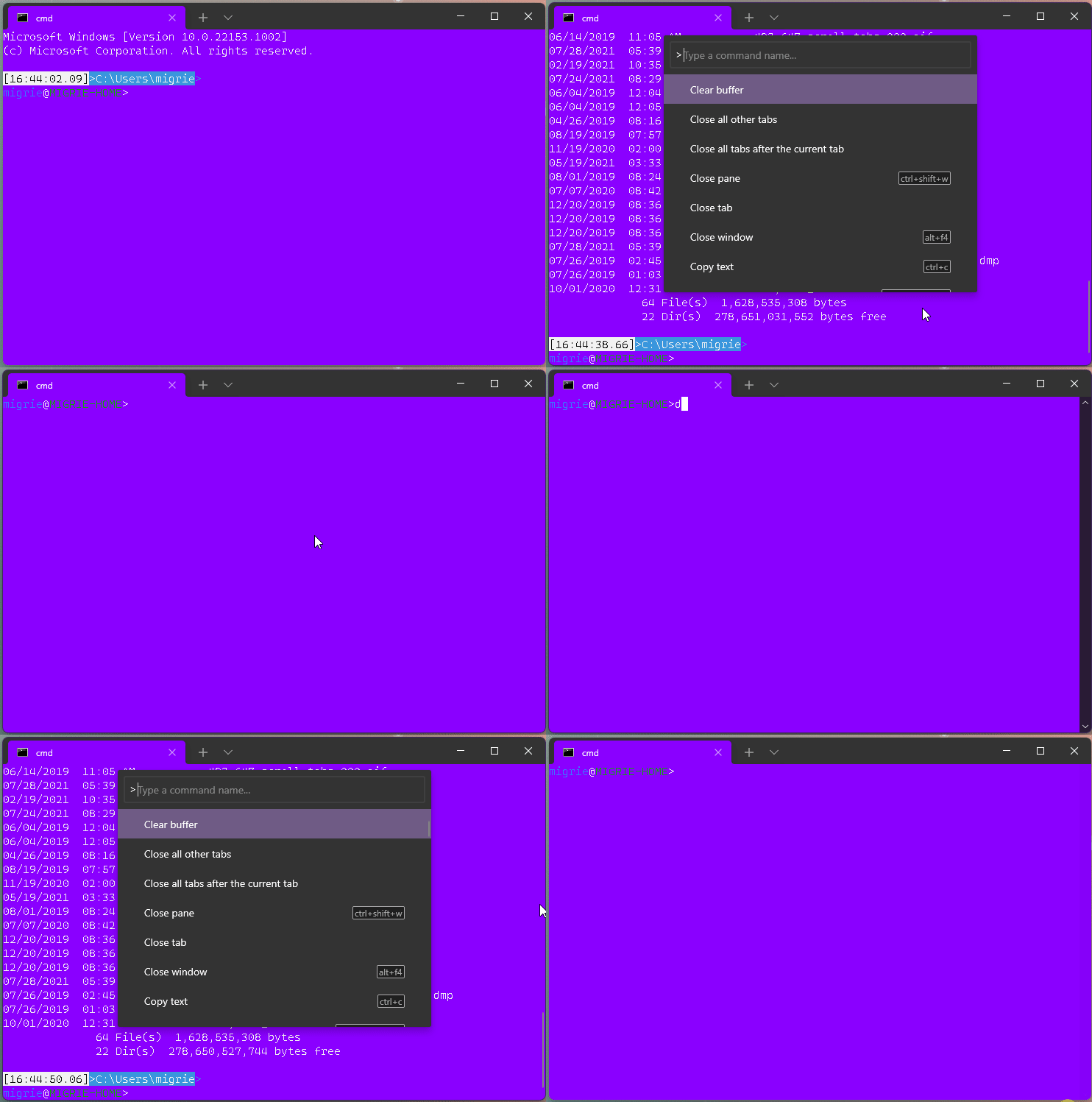
This adds a new action, `clearBuffer`. It accepts 3 values for the `clear` type:
* `"clear": "screen"`: Clear the terminal viewport content. Leaves the scrollback untouched. Moves the cursor row to the top of the viewport (unmodified).
* `"clear": "scrollback"`: Clear the scrollback. Leaves the viewport untouched.
* `"clear": "all"`: (**default**) Clear the scrollback and the visible viewport. Moves the cursor row to the top of the viewport (unmodified).
"Clear Buffer" has also been added to `defaults.json`.
## References
* From microsoft/vscode#75141 originally
## PR Checklist
* [x] Closes#1193
* [x] Closes#1882
* [x] I work here
* [x] Tests added/passed
* [ ] Requires documentation to be updated
## Detailed Description of the Pull Request / Additional comments
This is a bit tricky, because we need to plumb it all the way through conpty to clear the buffer. If we don't, then conpty will immediately just redraw the screen. So this sends a signal to the attached conpty, and then waits for conpty to draw the updated, cleared, screen back to us.
## Validation Steps Performed
* works for each of the three clear types as expected
* tests pass.
* works even with `ping -t 8.8.8.8` as you'd hope.
This commit introduces a hack to ConptyConnection for launching WSL.
When we detect that WSL is being launched (either "wsl" or "wsl.exe",
unqialified or _specifically_ from the current OS's System32 directory),
we will promote the startingDirectory specified at launch time into a
commandline argument.
Why do we want to switch to `--cd`?
With the current design of ConptyConnection and WSL, there are some
significant limitations:
* `startingDirectory` cannot be a WSL path, which forces users to
use weird tricks such as setting the starting directory to
`\\wsl$\Distro\home\user`.
* WSL occasionally fails to launch in time to handle a `\\wsl$` path,
which makes us spawn in a strange location (or no location at all).
(This fix will only address the second one until a WSL update is
released that adds support for `--cd $LINUX_PATH`.)
We will not do the promotion if any of the following are true:
* the commandline contains `--cd` already
* the commandline contains a bare `~`
* This was a commonly-used workaround that forced wsl to start in the
user's home directory. It conflicts with --cd.
* wsl is not spelled properly (`WSL` and `WSL.EXE` are unacceptable)
* an absolute path to wsl outside the system32 directory is provided
We chose the do this trick in the connection layer, the latest possible
point, because it captures the most use cases.
We could have done it earlier, but the options were quite limiting.
They are:
* Generate WSL profiles with startingDirectory set to the home folder
* We can't do this because we do not know the user's home folder
path.
* Generate WSL profiles with `--cd` in them.
* This only works for unmodified profiles.
* This only works for generated profiles.
* Users cannot override the commandline without breaking it.
* Users cannot specify a startingDirectory (!) since the one on the
commandline wins.
* Set a flag on generated WSL profiles to request this trick
* This only works for generated profiles. Users who create their own
WSL profiles couldn't set startingDirectory and have it work the
same.
Patching the commandline, hacky though it may be, seemed to be the most
compatible option. Eventually, we can even support `wt -d ~ wsl`!
## Validation Steps Performed
Manual validation for the following cases:
```c++
// MUST MANGLE
auto a01 = _tryMangleStartingDirectoryForWSL(LR"(wsl)", L"SENTINEL");
auto a02 = _tryMangleStartingDirectoryForWSL(LR"(wsl -d X)", L"SENTINEL");
auto a03 = _tryMangleStartingDirectoryForWSL(LR"(wsl -d X ~/bin/sh)", L"SENTINEL");
auto a04 = _tryMangleStartingDirectoryForWSL(LR"(wsl.exe)", L"SENTINEL");
auto a05 = _tryMangleStartingDirectoryForWSL(LR"(wsl.exe -d X)", L"SENTINEL");
auto a06 = _tryMangleStartingDirectoryForWSL(LR"(wsl.exe -d X ~/bin/sh)", L"SENTINEL");
auto a07 = _tryMangleStartingDirectoryForWSL(LR"("wsl")", L"SENTINEL");
auto a08 = _tryMangleStartingDirectoryForWSL(LR"("wsl.exe")", L"SENTINEL");
auto a09 = _tryMangleStartingDirectoryForWSL(LR"("wsl" -d X)", L"SENTINEL");
auto a10 = _tryMangleStartingDirectoryForWSL(LR"("wsl.exe" -d X)", L"SENTINEL");
auto a11 = _tryMangleStartingDirectoryForWSL(LR"("C:\Windows\system32\wsl.exe" -d X)", L"SENTINEL");
auto a12 = _tryMangleStartingDirectoryForWSL(LR"("C:\windows\system32\wsl" -d X)", L"SENTINEL");
auto a13 = _tryMangleStartingDirectoryForWSL(LR"(wsl ~/bin)", L"SENTINEL");
// MUST NOT MANGLE
auto a14 = _tryMangleStartingDirectoryForWSL(LR"("C:\wsl.exe" -d X)", L"SENTINEL");
auto a15 = _tryMangleStartingDirectoryForWSL(LR"(C:\wsl.exe)", L"SENTINEL");
auto a16 = _tryMangleStartingDirectoryForWSL(LR"(wsl --cd C:\)", L"SENTINEL");
auto a17 = _tryMangleStartingDirectoryForWSL(LR"(wsl ~)", L"SENTINEL");
auto a18 = _tryMangleStartingDirectoryForWSL(LR"(wsl ~ -d Ubuntu)", L"SENTINEL");
```
We don't have anywhere to put TerminalConnection unit tests :|
Closes#592.


