mirror of
https://github.com/microsoft/terminal.git
synced 2025-12-11 04:38:24 -06:00
13 Commits
| Author | SHA1 | Message | Date | |
|---|---|---|---|---|
 Michael Niksa
|
2c2f4f9be2
|
[FHL] Make VTApiRoutines, which does VT translation for output (#11264)
Make a VTApiRoutines servicer that does minimal translations instead of environmental simulation for some output methods. Remaining methods are backed on the existing console host infrastructure (primarily input related methods). ## PR Checklist * [x] I work here * [x] It's Fix-Hack-Learn quality so it's behind a feature gate so we can keep refining it. But it's a start! To turn this on, you will have to be in the Dev or Preview rings (feature staged). Then add `experimental.connection.passthroughMode: true` to a profile and on the next launch, the flags will propagate down through the `ConptyConnection` into the underlying `Openconsole.exe` startup and tell it to use the passthrough mode instead of the full simulation mode. ## Validation Steps Performed - Played with it manually in CMD.exe, it seems to work mostly. - Played with it manually in Ubuntu WSL, it seems to work. - Played with it manually in Powershell and it's mostly sad. It'll get there. Starts #1173 |
||
|
James Holderness
|
62c95b5017
|
Move the common render settings into a shared class (#12127)
## Summary of the Pull Request This PR moves the color table and related render settings, which are common to both conhost and Windows Terminal, into a shared class that can be accessed directly from the renderer. This avoids the overhead of having to look up these properties via the `IRenderData` interface, which relies on inefficient virtual function calls. This also introduces the concept of color aliases, which determine the position in the color table that colors like the default foreground and background are stored. This allows the option of mapping them to one of the standard 16 colors, or to have their own separate table entries. ## References This is a continuation of the color table refactoring started in #11602 and #11784. The color alias functionality is a prerequisite for supporting a default bold color as proposed in #11939. The color aliases could also be a way for us to replace the PowerShell color quirk for #6807. ## PR Checklist * [x] Closes #12002 * [x] CLA signed. * [ ] Tests added/passed * [ ] Documentation updated. * [ ] Schema updated. * [ ] I've discussed this with core contributors already. If not checked, I'm ready to accept this work might be rejected in favor of a different grand plan. Issue number where discussion took place: #xxx ## Detailed Description of the Pull Request / Additional comments In addition to the color table, this new `RenderSettings` class manages the blinking state, the code for adjusting indistinguishable colors, and various boolean properties used in the color calculations. These boolean properties are now stored in a `til::enumset` so they can all be managed through a single `SetRenderMode` API, and easily extended with additional modes that we're likely to need in the future. In Windows Terminal we have an instance of `RenderSettings` stored in the `Terminal` class, and in conhost it's stored in the `Settings` class. In both cases, a reference to this class is passed to the `Renderer` constructor, so it now has direct access to that data. The renderer can then pass that reference to the render engines where it's needed in the `UpdateDrawingBrushes` method. This means the renderer no longer needs the `IRenderData` interface to access the `GetAttributeColors`, `GetCursorColor`, or `IsScreenReversed` methods, so those have now been removed. We still need access to `GetAttributeColors` in certain accessibility code, though, so I've kept that method in the `IUIAData` interface, but the implementation just forwards to the `RenderSettings` class. The implementation of the `RenderSettings::GetAttributeColors` method is loosely based on the original `Terminal` code, only the `CalculateRgbColors` call has now been incorporated directly into the code. This let us deduplicate some bits that were previously repeated in the section for adjusting indistinguishable colors. The last steps, where we calculate the alpha components, have now been split in to a separate `GetAttributeColorsWithAlpha` method, since that's typically not needed. ## Validation Steps Performed There were quite a lot changes needed in the unit tests, but they're mostly straightforward replacements of one method call with another. In the `TextAttributeTests`, where we were previously testing the `CalculateRgbColors` method, we're now running those tests though `RenderSettings::GetAttributeColors`, which incorporates the same functionality. The only complication is when testing the `IntenseIsBright` option, that needs to be set with an additional `SetRenderMode` call where previously it was just a parameter on `CalculateRgbColors`. In the `ScreenBufferTests` and `TextBufferTests`, calls to `LookupAttributeColors` have again been replaced by the `RenderSettings::GetAttributeColors` method, which serves the same purpose, and calls to `IsScreenReversed` have been replaced with an appropriate `GetRenderMode` call. In the `VtRendererTests`, all the calls to `UpdateDrawingBrushes` now just need to be passed a reference to a `RenderSettings` instance. |
||
|
James Holderness
|
90ff261c35
|
Add support for downloadable soft fonts (#10011)
This PR adds conhost support for downloadable soft fonts - also known as dynamically redefinable character sets (DRCS) - using the `DECDLD` escape sequence. These fonts are typically designed to work on a specific terminal model, and each model tends to have a different character cell size. So in order to support as many models as possible, the code attempts to detect the original target size of the font, and then scale the glyphs to fit our current cell size. Once a font has been downloaded to the terminal, it can be designated in the same way you would a standard character set, using an `SCS` escape sequence. The identification string for the set is defined by the `DECDLD` sequence. Internally we map the characters in this set to code points `U+EF20` to `U+EF7F` in the Unicode private use are (PUA). Then in the renderer, any characters in that range are split off into separate runs, which get painted with a special font. The font itself is dynamically generated as an in-memory resource, constructed from the downloaded character bitmaps which have been scaled to the appropriate size. If no soft fonts are in use, then no mapping of the PUA code points will take place, so this shouldn't interfere with anyone using those code points for something else, as along as they aren't also trying to use soft fonts. I also tried to pick a PUA range that hadn't already been snatched up by Nerd Fonts, but if we do receive reports of a conflict, it's easy enough to change. ## Validation Steps Performed I added an adapter test that runs through a bunch of parameter variations for the `DECDLD` sequence, to make sure we're correctly detecting the font sizes for most of the known DEC terminal models. I've also tested manually on a wide range of existing fonts, of varying dimensions, and from multiple sources, and made sure they all worked reasonably well. Closes #9164 |
||
|
PankajBhojwani
|
614507b95b
|
OSC 8 support for conhost and terminal (#7251)
<!-- Enter a brief description/summary of your PR here. What does it fix/what does it change/how was it tested (even manually, if necessary)? --> ## Summary of the Pull Request Conhost can now support OSC8 sequences (as specified [here](https://gist.github.com/egmontkob/eb114294efbcd5adb1944c9f3cb5feda)). Terminal also supports those sequences and additionally hyperlinks can be opened by Ctrl+LeftClicking on them. <!-- Other than the issue solved, is this relevant to any other issues/existing PRs? --> ## References #204 <!-- Please review the items on the PR checklist before submitting--> ## PR Checklist * [X] Closes #204 * [ ] CLA signed. If not, go over [here](https://cla.opensource.microsoft.com/microsoft/Terminal) and sign the CLA * [ ] Tests added/passed * [ ] Documentation updated. If checked, please file a pull request on [our docs repo](https://github.com/MicrosoftDocs/terminal) and link it here: #xxx * [ ] Schema updated. * [ ] I've discussed this with core contributors already. If not checked, I'm ready to accept this work might be rejected in favor of a different grand plan. Issue number where discussion took place: #xxx <!-- Provide a more detailed description of the PR, other things fixed or any additional comments/features here --> ## Detailed Description of the Pull Request / Additional comments Added support to: - parse OSC8 sequences and extract URIs from them (conhost and terminal) - add hyperlink uri data to textbuffer/screeninformation, associated with a hyperlink id (conhost and terminal) - attach hyperlink ids to text to allow for uri extraction from the textbuffer/screeninformation (conhost and terminal) - process ctrl+leftclick to open a hyperlink in the clicked region if present <!-- Describe how you validated the behavior. Add automated tests wherever possible, but list manual validation steps taken as well --> ## Validation Steps Performed Open up a PowerShell tab and type ```PowerShell ${ESC}=[char]27 Write-Host "${ESC}]8;;https://github.com/microsoft/terminal${ESC}\This is a link!${ESC}]8;;${ESC}\" ``` Ctrl+LeftClick on the link correctly brings you to the terminal page on github 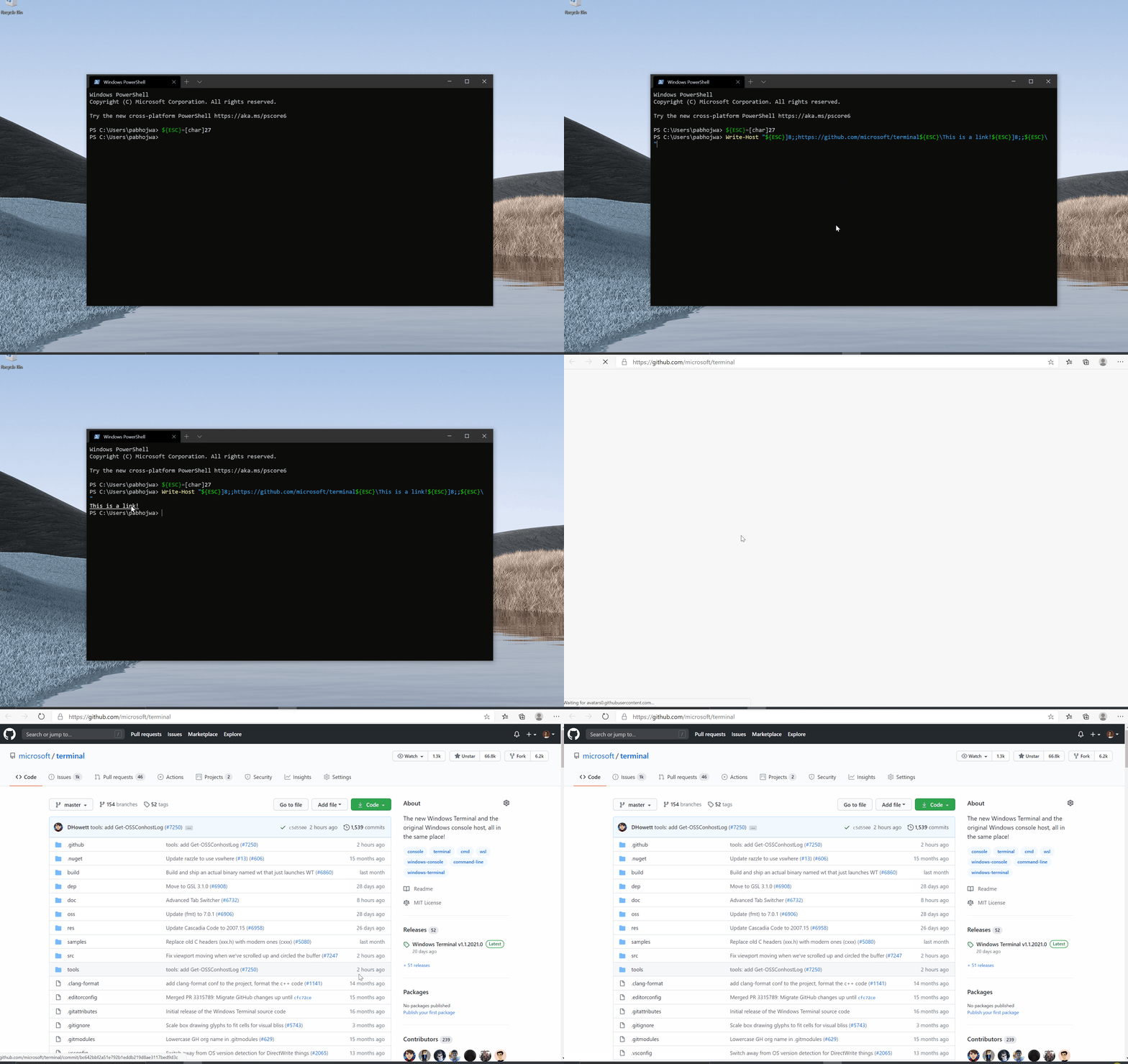 |
||
|
James Holderness
|
ddbe370d22
|
Improve the propagation of color attributes over ConPTY (#6506)
This PR reimplements the VT rendering engines to do a better job of preserving the original color types when propagating attributes over ConPTY. For the 16-color renderers it provides better support for default colors and improves the efficiency of the color narrowing conversions. It also fixes problems with the ordering of character renditions that could result in attributes being dropped. Originally the base renderer would calculate the RGB color values and legacy/extended attributes up front, passing that data on to the active engine's `UpdateDrawingBrushes` method. With this new implementation, the renderer now just passes through the original `TextAttribute` along with an `IRenderData` interface, and leaves it to the engines to extract the information they need. The GDI and DirectX engines now have to lookup the RGB colors themselves (via simple `IRenderData` calls), but have no need for the other attributes. The VT engines extract the information that they need from the `TextAttribute`, instead of having to reverse engineer it from `COLORREF`s. The process for the 256-color Xterm engine starts with a check for default colors. If both foreground and background are default, it outputs a SGR 0 reset, and clears the `_lastTextAttribute` completely to make sure any reset state is reapplied. With that out the way, the foreground and background are updated (if changed) in one of 4 ways. They can either be a default value (SGR 39 and 49), a 16-color index (using ANSI or AIX sequences), a 256-color index, or a 24-bit RGB value (both using SGR 38 and 48 sequences). Then once the colors are accounted for, there is a separate step that handles the character rendition attributes (bold, italics, underline, etc.) This step must come _after_ the color sequences, in case a SGR reset is required, which would otherwise have cleared any character rendition attributes if it came last (which is what happened in the original implementation). The process for the 16-color engines is a little different. The target client in this case (Windows telnet) is incapable of setting default colors individually, so we need to output an SGR 0 reset if _either_ color has changed to default. With that out the way, we use the `TextColor::GetLegacyIndex` method to obtain an approximate 16-color index for each color, and apply the bold attribute by brightening the foreground index (setting bit 8) if the color type permits that. However, since Windows telnet only supports the 8 basic ANSI colors, the best we can do for bright colors is to output an SGR 1 attribute to get a bright foreground. There is nothing we can do about a bright background, so after that we just have to drop the high bit from the colors. If the resulting index values have changed from what they were before, we then output ANSI 8-color SGR sequences to update them. As with the 256-color engine, there is also a final step to handle the character rendition attributes. But in this case, the only supported attributes are underline and reversed video. Since the VT engines no longer depend on the active color table and default color values, there was quite a lot of code that could now be removed. This included the `IDefaultColorProvider` interface and implementations, the `Find(Nearest)TableIndex` functions, and also the associated HLS conversion and difference calculations. VALIDATION Other than simple API parameter changes, the majority of updates required in the unit tests were to correct assumptions about the way the colors should be rendered, which were the source of the narrowing bugs this PR was trying to fix. Like passing white on black to the `UpdateDrawingBrushes` API, and expecting it to output the default `SGR 0` sequence, or passing an RGB color and expecting an indexed SGR sequence. In addition to that, I've added some VT renderer tests to make sure the rendition attributes (bold, underline, etc) are correctly retained when a default color update causes an `SGR 0` sequence to be generated (the source of bug #3076). And I've extended the VT renderer color tests (both 256-color and 16-color) to make sure we're covering all of the different color types (default, RGB, and both forms of indexed colors). I've also tried to manually verify that all of the test cases in the linked bug reports (and their associated duplicates) are now fixed when this PR is applied. Closes #2661 Closes #3076 Closes #3717 Closes #5384 Closes #5864 This is only a partial fix for #293, but I suspect the remaining cases are unfixable. |
||
|
James Holderness
|
fa7c1abdf8
|
Fix SGR indexed colors to distinguish Indexed256 color (and more) (#5834)
This PR introduces a new `ColorType` to allow us to distinguish between `SGR` indexed colors from the 16 color table, the lower half of which can be brightened, and the ISO/ITU indexed colors from the 256 color table, which have a fixed brightness. Retaining the distinction between these two types will enable us to forward the correct `SGR` sequences to conpty when addressing issue #2661. The other benefit of retaining the color index (which we didn't previously do for ISO/ITU colors) is that it ensures that the colors are updated correctly when the color scheme is changed. ## References * This is another step towards fixing the conpty narrowing bugs in issue #2661. * This is technically a fix for issue #5384, but that won't be apparent until #2661 is complete. ## PR Checklist * [x] Closes #1223 * [x] CLA signed. * [x] Tests added/passed * [ ] Requires documentation to be updated * [x] I've discussed this with core contributors already. ## Detailed Description of the Pull Request / Additional comments The first part of this PR was the introduction of a new `ColorType` in the `TextColor` class. Instead of just the one `IsIndex` type, there is now an `IsIndex16` and an `IsIndex256`. `IsIndex16` covers the eight original ANSI colors set with `SGR 3x` and `SGR 4x`, as well as the brighter aixterm variants set with `SGR 9x` and `SGR 10x`. `IsIndex256` covers the 256 ISO/ITU indexed colors set with `SGR 38;5` and `SGR 48;5`. There are two reasons for this distinction. The first is that the ANSI colors have the potential to be brightened by the `SGR 1` bold attribute, while the ISO/ITO color do not. The second reason is that when forwarding an attributes through conpty, we want to try and preserve the original SGR sequence that generated each color (to the extent that that is possible). By having the two separate types, we can map the `IsIndex16` colors back to ANSI/aixterm values, and `IsIndex256` to the ISO/ITU sequences. In addition to the VT colors, we also have to deal with the legacy colors set by the Windows console APIs, but we don't really need a separate type for those. It seemed most appropriate to me to store them as `IsIndex256` colors, since it doesn't make sense to have them brightened by the `SGR 1` attribute (which is what would happen if they were stored as `IsIndex16`). If a console app wanted a bright color it would have selected one, so we shouldn't be messing with that choice. The second part of the PR was the unification of the two color tables. Originally we had a 16 color table for the legacy colors, and a separate table for the 256 ISO/ITU colors. These have now been merged into one, so color table lookups no longer need to decide which of the two tables they should be referencing. I've also updated all the methods that took a color table as a parameter to use a `basic_string_view` instead of separate pointer and length variables, which I think makes them a lot easier and safer to work with. With this new architecture in place, I could now update the `AdaptDispatch` SGR implementation to store the ISO/ITU indexed colors as `IsIndex256` values, where before they were mapped to RGB values (which prevented them reflecting any color scheme changes). I could also update the `TerminalDispatch` implementation to differentiate between the two index types, so that the `SGR 1` brightening would only be applied to the ANSI colors. I've also done a bit of code refactoring to try and minimise any direct access to the color tables, getting rid of a lot of places that were copying tables with `memmove` operations. I'm hoping this will make it easier for us to update the code in the future if we want to reorder the table entries (which is likely a requirement for unifying the `AdaptDispatch` and `TerminalDispatch` implementations). ## Validation Steps Performed For testing, I've just updated the existing unit tests to account for the API changes. The `TextColorTests` required an extra parameter specifying the index type when setting an index. And the `AdapterTest` and `ScreenBufferTests` required the use of the new `SetIndexedXXX` methods in order to be explicit about the index type, instead of relying on the `TextAttribute` constructor and the old `SetForeground` and `SetBackground` methods which didn't have a way to differentiate index types. I've manually tested the various console APIs (`SetConsoleTextAttribute`, `ReadConsoleOutputAttribute`, and `ReadConsoleOutput`), to make sure they are still setting and reading the attributes as well as they used to. And I've tested the `SetConsoleScreenBufferInfoEx` and `GetConsoleScreenBufferInfoEx` APIs to make sure they can read and write the color table correctly. I've also tested the color table in the properties dialog, made sure it was saved and restored from the registry correctly, and similarly saved and restored from a shortcut link. Note that there are still a bunch of issues with the color table APIs, but no new problems have been introduced by the changes in this PR, as far as I could tell. I've also done a bunch of manual tests of `OSC 4` to make sure it's updating all the colors correctly (at least in conhost), and confirmed that the test case in issue #1223 now works as expected. |
||
|
Mike Griese
|
7612044363
|
Implement a pair of shims for cls, Clear-Host in conpty mode (#5627)
## Summary of the Pull Request This PR implements a pair of shims for `cmd` and `powershell`, so that their `cls` and `Clear-Host` functions will clear the entire terminal buffer (like they do in conhost), instead of just the viewport. With the conpty viewport and buffer being the same size, there's effectively no way to know if an application is calling these API's in this way with the intention of clearing the buffer or the viewport. We absolutely have to guess. Each of these shims checks to see if the way that the API is being called exactly matches the way `cmd` or `powershell` would call these APIs. If it does, we manually write a `^[[3J` to the connected terminal, to get he Terminal to clear it's own scrollback. ~~_⚠️ If another application were trying to clear the **viewport** with an exactly similar API call, this would also cause the terminal scrollback to get cleared ⚠️_~~ * [x] Should these shims be restricted to when the process that's calling them is actually `cmd.exe` or `powershell.exe`? Can I even do this? I think we've done such a good job of isolating the client process information from the rest of the host code that I can't figure out how to do this. - YES, this can be done, and I did it. * [ ] **TODO**: _While I'm here_, should I have `DoSrvPrivateEraseAll` (the implementation for `^[[2J`, in `getset.cpp`) also manually trigger a EraseAll in the terminal in conpty mode? ## PR Checklist * [x] Closes #3126 * [x] Actually closes #1305 too, which is really the same thing, but probably deserves a callout * [x] I work here * [x] Tests added/passed * [n/a] Requires documentation to be updated ## Validation Steps Performed * ran tests * checked `cls` in the Terminal * checked `Clear-Host` in the Terminal * Checked running `powershell clear-host` from `cmd.exe` |
||
|
Mike Griese
|
62765f152e |
Create tests that roundtrip output through a conpty to a Terminal (#4213)
## Summary of the Pull Request This PR adds two tests: * First, I started by writing a test where I could write output to the console host and inspect what output came out of conpty. This is the `ConptyOutputTests` in the host unit tests. * Then I got crazy and thought _"what if I could take that output and dump it straight into the `Terminal`"_? Hence, the `ConptyRoundtripTests` were born, into the TerminalCore unit tests. ## References Done in pursuit of #4200, but I felt this warranted it's own atomic PR ## PR Checklist * [x] Doesn't close anything on it's own. * [x] I work here * [x] you better believe this adds tests * [n/a] Requires documentation to be updated ## Detailed Description of the Pull Request / Additional comments From the comment in `ConptyRoundtripTests`: > This test class creates an in-proc conpty host as well as a Terminal, to > validate that strings written to the conpty create the same resopnse on the > terminal end. Tests can be written that validate both the contents of the > host buffer as well as the terminal buffer. Everytime that > `renderer.PaintFrame()` is called, the tests will validate the expected > output, and then flush the output of the VtEngine straight to th Also, some other bits had to be updated: * The renderer needed to be able to survive without a thread, so I hadded a simple check that it actually had a thread before calling `pThread->NotifyPaint` * Bits in `CommonState` used `NTSTATUS_FROM_HRESULT` which did _not_ work outside the host project. Since the `NTSTATUS` didn't seem that important, I replaced that with a `HRESULT` * `CommonState` likes to initialize the console to some _weird_ defaults. I added an optional param to let us just use the defaults. |
||
|
Michael Niksa
|
4dd476ecbd
|
Revert locking changes (#3488)
This reverts commit 56c35945b97ff59621959f621fa9ab5d0ec7e158. Also patches up some build fixes made after it and corrects a VtRendererTest that was dependent on the locks. |
||
|
Mike Griese
|
dec5c11e19
|
Add support for passing through extended text attributes, like… (#2917)
## Summary of the Pull Request Adds support for Italics, Blinking, Invisible, CrossedOut text, THROUGH CONPTY. This does **NOT** add support for those styles to conhost or the terminal. We will store these "Extended Text Attributes" in a `TextAttribute`. When we go to render a line, we'll see if the state has changed from our previous state, and if so, we'll appropriately toggle that state with VT. Boldness has been moved from a `bool` to a single bit in these flags. Technically, now that these are stored in the buffer, we only need to make changes to the renderers to be able to support them. That's not being done as a part of this PR however. ## References See also #2915 and #2916, which are some follow-up tasks from this fix. I thought them too risky for 20H1. ## PR Checklist * [x] Closes #2554 * [x] I work here * [x] Tests added/passed * [n/a] Requires documentation to be updated <hr> * store text with extended attributes too * Plumb attributes through all the renderers * parse extended attrs, though we're not renderering them right * Render these states correctly * Add a very extensive test * Cleanup for PR * a block of PR feedback * add 512 test cases * Fix the build * Fix @carlos-zamora's suggestions * @miniksa's PR feedback |
||
|
Michael Niksa
|
56c35945b9
|
Rework locking and eventing during startup and shutdown to alleviate some VT issues (#2525)
Adjusts the startup and shutdown behavior of most threads in the console host to alleviate race conditions that are either exacerbated or introduced by the VT PTY threads. |
||
|
adiviness
|
9b92986b49
|
add clang-format conf to the project, format the c++ code (#1141) | ||
|
Dustin Howett
|
d4d59fa339 |
Initial release of the Windows Terminal source code
This commit introduces all of the Windows Terminal and Console Host source, under the MIT license. |
